
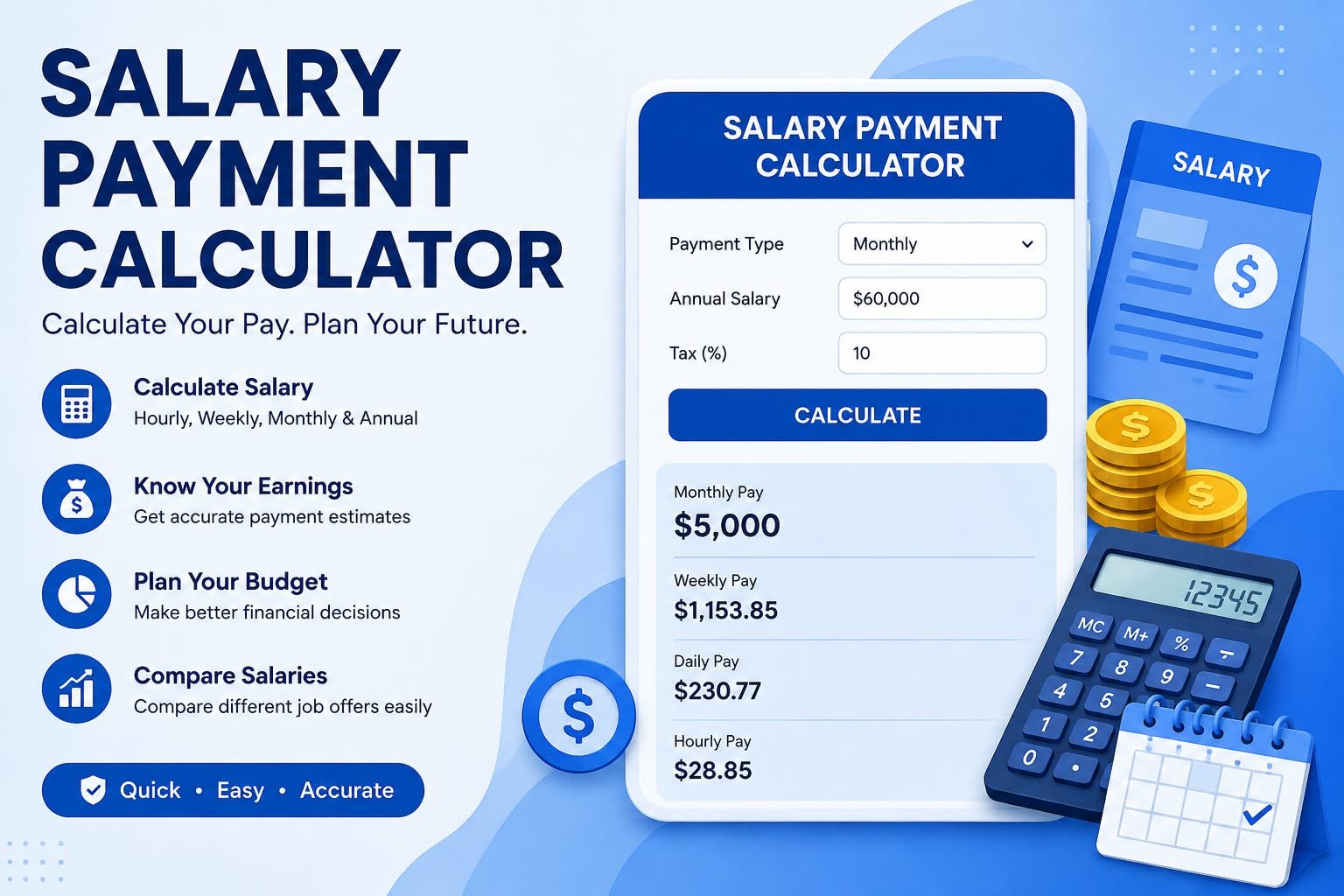
A Salary Payment Calculator is a useful online tool that helps employees, freelancers, and workers estimate how much they should receive for their work.
Instead of calculating income manually, a salary payment calculator can quickly convert hourly, weekly, monthly, or annual pay into an easy-to-understand salary amount.
Whether you receive a fixed salary or are paid according to the hours you work, understanding your earnings is important for budgeting and financial planning.
A salary calculator can make these calculations much easier and reduce the possibility of basic mathematical mistakes.
What Is a Salary Payment Calculator?
A salary payment calculator is a digital tool designed to estimate salary payments based on different pay details. Depending on the calculator, you may enter your hourly rate, working hours, payment frequency, annual salary, or other information.
For example, if you know your hourly wage and average weekly working hours, the calculator can estimate your weekly, monthly, and yearly earnings.
This makes it easier to understand your total income.
How Does a Salary Payment Calculator Work?
Most salary payment calculators use simple mathematical formulas. For an hourly employee, estimated weekly pay can be calculated by multiplying the hourly rate by the number of hours worked.
Hourly Rate × Hours Worked = Weekly Salary
For example, someone earning $15 per hour and working 40 hours per week would have an estimated weekly income of $600 before taxes and other deductions.
The exact calculation can vary depending on overtime, working days, payment frequency, bonuses, and deductions.
Why Use a Salary Payment Calculator?
A Salary Payment Calculator can be helpful in many situations.
It allows you to estimate your income before accepting a job, compare different salary offers, or plan your monthly expenses.
It can also help you understand the difference between hourly and annual pay.
Employees who are considering a new job can use a calculator to compare their current earnings with a potential salary.
Another benefit is convenience. Instead of performing several calculations manually, you can enter your information into an online calculator and get an estimate quickly.
Calculate Hourly, Weekly, Monthly, and Annual Salary
One of the most useful features of a salary calculator is the ability to convert income between different payment periods.
For example, an employee may know their annual salary but want to know their approximate monthly or weekly income. Similarly, an hourly worker may want to estimate their annual earnings.
Common salary periods include:
- Hourly salary
- Daily salary
- Weekly salary
- Biweekly salary
- Monthly salary
- Annual salary
These conversions provide a clearer picture of total earnings and can be useful when creating a personal budget.
Salary Payment Calculator and Taxes
It is important to understand that a basic salary payment calculation may show gross income, not the amount you actually receive in your bank account.
Gross salary is the amount earned before deductions. Net salary, often called take-home pay, is the amount remaining after applicable taxes and other deductions.
Taxes, insurance, retirement contributions, and other deductions can vary depending on your location and employment situation. Therefore, a simple salary calculator should be treated as an estimate unless it specifically includes accurate local tax calculations.
Salary Payment Calculator for Job Comparison
A salary payment calculator can also help when comparing job opportunities. One company may offer an hourly wage while another offers an annual salary.
Rather than comparing only the numbers, you can convert both offers into the same payment period. This gives you a better understanding of how the salaries compare.
You should also consider working hours, overtime, bonuses, paid leave, and other benefits when evaluating a job offer.
How to Use a Salary Payment Calculator
Using a salary payment calculator is generally simple. First, enter your salary or hourly pay rate. Next, provide the number of hours you normally work if the calculation requires it.
Then select the payment period, such as weekly, monthly, or annually. The calculator can provide an estimated payment based on the information you entered.
For the most accurate result, always use current and correct salary information.
Final Thoughts
A Salary Payment Calculator is a convenient way to understand your earnings across different payment periods. Whether you are an employee, freelancer, or job seeker, calculating your expected income can help with budgeting, job comparisons, and financial planning.
Remember that calculator results are estimates when taxes, overtime, bonuses, or deductions are not included. For a more accurate picture of your take-home pay, use a calculator that supports the relevant deductions and tax rules for your location.
A Salary Payment Calculator is a simple and useful online tool that helps people estimate their earnings based on their salary, hourly wage, working hours, and payment schedule.
Understanding your income is important whether you are an employee, freelancer, part-time worker, or someone comparing different job opportunities.
Instead of performing complicated calculations manually, a salary payment calculator can provide a quick estimate of your expected earnings.
Depending on the calculator, users may be able to calculate hourly, daily, weekly, biweekly, monthly, or annual income.
This makes it easier to understand how much money you may earn over a particular period. For employees who receive an annual salary, converting that amount into monthly or weekly payments can help with budgeting and everyday financial planning.
For hourly workers, entering the hourly pay rate and number of hours worked can help estimate total earnings. For example, if a worker earns $20 per hour and works 40 hours per week, their estimated weekly gross income would be $800 before taxes and other deductions.
Over time, this information can help workers understand their overall earning potential.
A Salary Payment Calculator can also be useful when comparing job offers. One employer may offer an hourly wage while another may provide an annual salary.
Converting both offers into the same payment period makes comparison easier. However, salary should not be the only factor considered when comparing employment opportunities.
Working hours, overtime, bonuses, paid holidays, insurance, retirement contributions, and other benefits may also affect the overall value of a job.
Another important feature of salary calculations is understanding the difference between gross and net income. Gross salary is the amount earned before deductions, while net salary is the amount an employee actually receives after applicable taxes and other deductions.
A basic salary payment calculator may only calculate gross earnings, so the final amount received can be different.
Tax rules and deductions vary depending on location, employment status, and individual circumstances. Therefore, users should treat general calculator results as estimates unless the calculator specifically supports local tax and deduction rules. A salary calculator can also help people create realistic budgets.
Knowing an estimated monthly income makes it easier to plan expenses such as housing, food, transportation, education, savings, and other regular costs.
Workers who are paid weekly or biweekly can convert their earnings into a monthly or annual estimate to better understand their overall income.
Similarly, someone with an annual salary can estimate their regular payment amount and organize their finances accordingly.
When using a Salary Payment Calculator, it is important to enter accurate information.
Users should check their hourly rate or annual salary, working hours, payment frequency, and overtime details if applicable.
Small differences in these figures can change the final estimate. Some calculators may also allow users to include bonuses, commissions, unpaid time off, or additional working hours.
These options can make the calculation more useful for people whose income changes from one payment period to another. Freelancers and independent workers can also benefit from salary calculations.
Their income may not follow a traditional fixed monthly salary, so estimating earnings from hourly rates or project payments can help them understand their average income.
They can use these estimates to plan expenses and evaluate whether their current rates are suitable for their workload.
A Salary Payment Calculator can also be helpful when negotiating pay. Before discussing a new salary or hourly rate, workers can calculate how different rates could affect their estimated annual or monthly earnings.
This provides a clearer understanding of the financial difference between two offers. For example, even a small increase in hourly pay can create a noticeable difference over many working hours.
The same principle applies to annual salary increases. In addition, salary calculations can help employees understand the impact of changing working hours.
A person moving from full-time to part-time work can estimate how their income may change, while someone considering overtime can calculate the potential additional earnings.
These estimates can support better personal planning. It is important to remember that salary calculators do not replace official payroll statements.
Actual payments may depend on taxes, government deductions, employer policies, benefits, overtime rules, and other factors.
For this reason, calculator results should be used as estimates rather than guaranteed payment amounts. Overall, a Salary Payment Calculator is a practical tool for anyone who wants a clearer understanding of their income.
It can convert salary information into different payment periods, support job comparisons, assist with budgeting, and help users understand the relationship between hourly and annual earnings.
By entering accurate information and understanding the difference between gross and net pay, users can get more useful results.
Whether you are checking your current earnings, planning a budget, comparing job offers, or estimating future income, a salary payment calculator can make salary calculations faster, easier, and more convenient.
Why Use a Salary Payment Calculator?
One Response