
Salary Comparison Calculator: Compare Salaries and Make Better Career Decisions
Choosing between two jobs can be difficult when the salaries look different. One company may offer a higher annual salary, while another may provide better benefits, bonuses, or flexible working options. A Salary Comparison Calculator can make this decision easier by helping you compare different salary offers in a simple and organized way.
What Is a Salary Comparison Calculator?
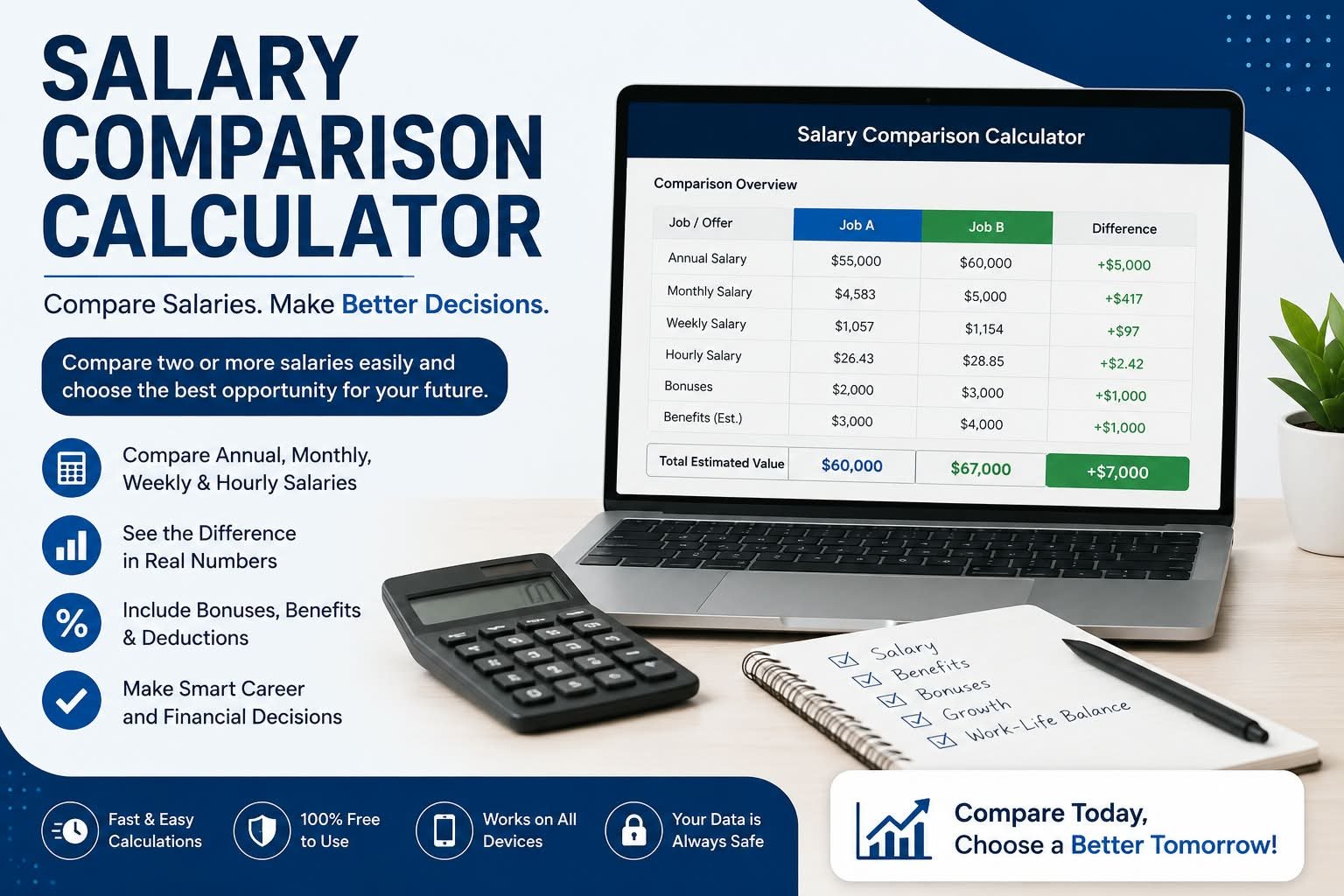
A Salary Comparison Calculator is an online tool that helps users compare two or more salaries. Instead of looking only at the yearly salary, you can compare income based on monthly, weekly, daily, or hourly earnings.
For example, if one job offers $50,000 per year and another offers $55,000, the second job may initially look better. However, if the second job requires significantly more working hours or has fewer benefits, the first offer could still be more suitable.
A salary comparison tool allows you to understand the difference between offers and make a more informed decision.
Why Use a Salary Comparison Calculator?
Comparing salaries manually can take time and may lead to mistakes. A calculator can quickly show the difference between different income levels.
It can be useful when:
- Comparing two job offers
- Negotiating a salary
- Considering a promotion
- Changing careers
- Comparing full-time and part-time jobs
- Comparing hourly and annual pay
- Planning your future income
The tool can also help you understand how a small salary difference can affect your income over an entire year.
How Does a Salary Comparison Calculator Work?
Most salary comparison calculators require basic information such as salary amount, payment frequency, and working hours.
You may enter an annual salary for one job and compare it with another annual salary. The calculator can then estimate the difference between the two salaries.
For example, suppose Job A pays $45,000 per year and Job B pays $50,000 per year. The difference is $5,000 annually. When converted into monthly income, this represents approximately $416.67 more per month before taxes.
These calculations can make salary differences easier to understand.
Compare Annual, Monthly, Weekly, and Hourly Salary
One important feature of a Salary Comparison Calculator is the ability to compare salaries using different pay periods.
An annual salary can be divided into monthly, weekly, or hourly amounts. This is particularly helpful when employers use different salary formats.
For example, one employer might advertise an annual salary, while another may advertise an hourly wage. Converting both offers to the same payment period makes the comparison easier.
However, these calculations are estimates because actual earnings can depend on working hours, overtime, holidays, taxes, and other factors.
Salary Comparison and Benefits
Salary is only one part of a job offer. Benefits can also have significant financial value.
When comparing two salaries, consider factors such as health coverage, paid vacation, retirement contributions, bonuses, transportation benefits, and other allowances.
For example, a job with a slightly lower salary could provide better benefits and fewer working hours. In some situations, this may make the overall package more attractive than a higher salary with limited benefits.
A calculator gives you a useful starting point, but you should consider the complete compensation package before making a final decision.
Salary Comparison for Job Offers
A Salary Comparison Calculator can be especially useful when you receive multiple job offers.
Start by entering the salary for each position. Then compare the annual and monthly differences. After that, consider working hours, benefits, bonuses, commute costs, and other expenses.
This approach gives you a broader picture of the value of each offer rather than focusing only on the headline salary.
Salary Comparison for Career Planning
Salary comparison is not only useful when changing jobs. It can also help with long-term career planning.
If you are considering learning a new skill, changing industries, or applying for a different position, comparing potential salaries can help you understand possible income differences.
You can compare your current salary with the expected salary for another position and calculate the potential increase or decrease Salary Comparison Calculator.
Final Thoughts
A Salary Comparison Calculator is a simple and useful tool for understanding differences between salaries. It can help you compare job offers, convert salaries between different pay periods, and estimate potential income changes.
Remember that salary should not be the only factor in a career decision. Working hours, benefits, job stability, career growth, location, and personal goals are also important.
By combining salary calculations with these other factors, you can make a more informed decision about your career and financial future.
How to Compare Two Salaries
Comparing two salaries becomes easier when both offers are converted into the same format. For example, if one employer offers an annual salary and another offers an hourly wage, it can be difficult to understand which offer provides more income. A Salary Comparison Calculator can help convert these figures and show the difference clearly.
Start by entering the salary for the first job and then enter the salary for the second job. Depending on the calculator, you may also be able to enter working hours, payment frequency, overtime, and other information. The calculator can then provide an estimated comparison.
This process saves time and reduces the need for manual calculations. It is especially useful for people who are considering a new job or preparing to negotiate their salary.
Gross Salary vs Net Salary
When comparing salaries, it is important to understand the difference between gross and net income. Gross salary is the amount earned before deductions such as taxes and other payroll deductions. Net salary is the amount that remains after applicable deductions.
Two jobs may have similar gross salaries but different take-home amounts because deductions can vary. This means that looking only at the advertised salary may not provide a complete picture.
A Salary Comparison Calculator can help organize salary information, but users should remember that actual net income depends on local tax rules, deductions, benefits, and individual circumstances.
Compare Hourly and Annual Pay
Many employees are paid an annual salary, while others receive an hourly wage. Comparing these two payment methods can be confusing without converting them into a common format.
For example, an employee earning an hourly wage may work a different number of hours each week than someone receiving a fixed annual salary. Working hours, overtime, holidays, and unpaid time can affect the final calculation.
A salary calculator can provide an estimated annual or hourly equivalent. This makes it easier to understand how different compensation structures compare.
Salary Comparison for Promotions
A Salary Comparison Calculator can also be useful when evaluating a promotion. A promotion may come with a higher salary, but it can also involve additional responsibilities or longer working hours.
Suppose an employee receives a salary increase from $40,000 to $45,000 per year. The calculator can show the annual difference and estimate the monthly difference before deductions.
This information can help employees understand the financial value of a promotion. However, it is also important to consider the responsibilities, career opportunities, and benefits associated with the new position.
Salary Comparison During a Job Change
Changing jobs can have a major impact on income. A new employer may offer a higher salary, but additional expenses can reduce the actual financial benefit.
For example, a new workplace might require a longer commute, resulting in higher transportation costs. Another job may offer remote work, flexible hours, or additional paid leave.
When using a Salary Comparison Calculator, consider both income and job-related expenses. Looking at the complete package can provide a more realistic comparison.
Factors to Consider Beyond Salary
Salary is an important part of employment, but it is not the only factor that matters. Employees should consider several other aspects before accepting an offer.
Important factors may include:
- Working hours
- Paid vacation
- Bonuses
- Retirement contributions
- Health benefits
- Transportation costs
- Remote or flexible work options
- Career development
- Job security
- Promotion opportunities
For example, a slightly lower salary may be attractive if the position offers better flexibility and significantly lower commuting expenses.
Salary Comparison for Freelancers
Freelancers and independent workers can also benefit from salary comparisons. Freelancers may receive different rates from different clients, making it useful to compare hourly, weekly, and annual income.
A freelancer can estimate how much they earn from each client and compare the amount with a traditional employment salary. However, freelancers should also account for business expenses, unpaid time, equipment costs, and other expenses.
This provides a more realistic understanding of the value of different freelance opportunities.
Using a Salary Comparison Calculator Effectively
To get the most useful result, enter accurate information into the calculator. Check whether the salary is hourly, weekly, monthly, or annual before entering it.
If the calculator allows working hours, enter realistic figures. If bonuses or additional compensation are included, make sure they are entered correctly.
It is also a good idea to compare several scenarios. For example, you could compare your current salary with a new job offer and then calculate how the result changes if you receive a raise.
Benefits of Online Salary Comparison Tools
Online salary comparison tools are convenient because they can provide calculations quickly. Users do not need to create complex formulas or manually convert payment periods.
These tools can be useful for employees, students, job seekers, freelancers, and business owners. They can also help users understand salary differences before making important career decisions.
However, calculators should be treated as estimation tools. Actual income may differ because of taxes, deductions, overtime, bonuses, benefits, and local employment rules.
Conclusion
A Salary Comparison Calculator provides a convenient way to compare different income levels and understand the financial difference between job opportunities. Whether you are evaluating a new position, considering a promotion, changing careers, or comparing hourly and annual pay, salary calculations can give you valuable information.
For the best decision, do not focus only on the highest salary. Consider the complete compensation package, working hours, benefits, expenses, career growth, and your personal goals.
Using a calculator together with careful research can make salary comparisons easier and help you make better-informed career and financial decisions.
How Does a Salary Comparison Calculator Work
One Response