
Understanding how much money you actually receive after taxes and other deductions can be confusing. Your gross salary may look attractive on paper, but the amount deposited into your bank account is usually lower because several deductions are taken from your earnings. These deductions can include income tax, retirement contributions, insurance payments, social security contributions, and other payroll adjustments.
A Salary Calculator for Salary Deductions can make this process much easier. It helps employees estimate their take-home pay by considering gross income and common deductions. Instead of manually performing several calculations, workers can use a calculator to get a clearer picture of their expected net salary.
Whether you are starting a new job, reviewing your paycheck, negotiating a salary, or planning your monthly budget, understanding salary deductions can help you make better financial decisions.
Table of Contents
ToggleWhat Are Salary Deductions?
Salary deductions are amounts removed from an employee’s gross earnings before the final net pay is received. Some deductions are required by law, while others may depend on an employee’s benefits, workplace policies, or personal choices.
Common deductions can include income taxes, social insurance contributions, retirement plans, health insurance, and other approved payroll deductions.
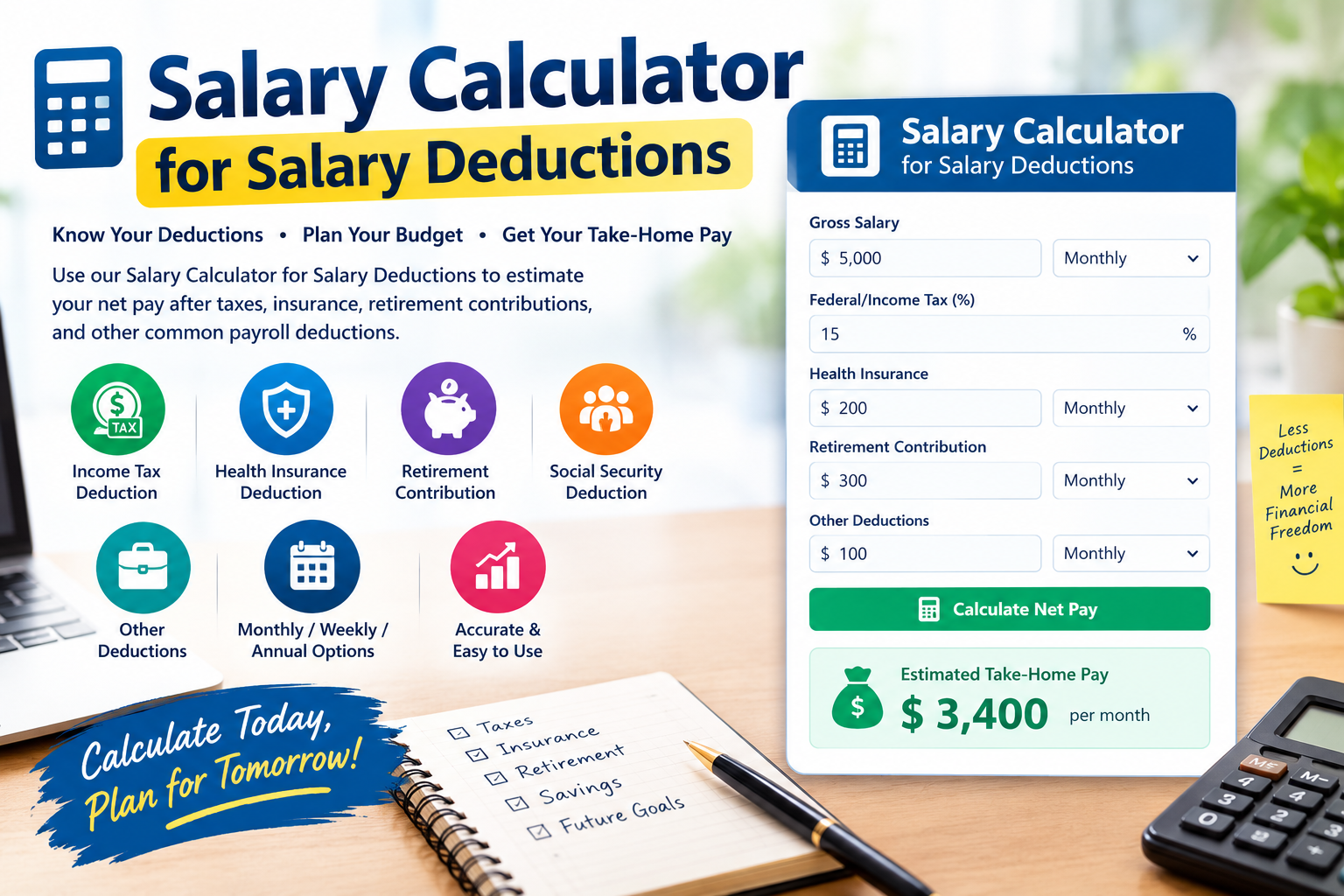
A Salary Calculator for Salary Deductions uses these amounts to estimate how much of your gross salary remains after deductions.
The exact deductions depend on factors such as your location, income level, employment status, tax rules, and benefits. Therefore, calculator results should generally be considered estimates rather than official payroll figures.
Gross Salary vs. Net Salary
Gross salary is the total amount an employee earns before deductions. Net salary, also called take-home pay, is the amount remaining after applicable deductions have been removed.
For example, imagine an employee has a gross monthly salary of $4,000. If taxes and other deductions total $800, the estimated take-home pay would be $3,200.
A Salary Calculator for Salary Deductions can help show the difference between gross and net income.
This distinction is important because employees often use their net salary when planning rent, food, transportation, savings, bills, and other monthly expenses.
Why Use a Salary Deduction Calculator?
Calculating payroll deductions manually can take time, especially when several deductions are involved. An online calculator can simplify the process and provide a quick estimate.
A Salary Calculator for Salary Deductions can be useful for employees who want to:
- Estimate their take-home pay
- Understand payroll deductions
- Compare different salary offers
- Plan monthly expenses
- Estimate annual net income
- Review expected paycheck amounts
- Understand the effect of taxes
- Prepare a personal budget
The calculator provides a convenient starting point for understanding how gross income can change after deductions.
Common Types of Salary Deductions
Salary deductions vary between employees, countries, and employers. However, several categories are commonly found on paychecks.
Income Tax
Income tax is one of the most common payroll deductions. The amount can depend on taxable income, tax brackets, filing status, allowances, and local regulations.
A Salary Calculator for Salary Deductions can include an estimated tax amount when the required information is entered.
Social Security Contributions
Some countries require employees to contribute toward social security or similar government programs. These contributions may be calculated as a percentage of eligible earnings.
Retirement Contributions
Employees may contribute part of their salary to a workplace retirement plan. In some cases, employers may also contribute separately.
Health Insurance
Health insurance premiums can sometimes be deducted directly from an employee’s paycheck. The amount depends on the selected plan and employer arrangements.
Other Payroll Deductions
Other deductions can include approved benefits, loan repayments, union fees, or other authorized amounts depending on the employment arrangement.
How a Salary Deduction Calculator Works
A typical Salary Calculator for Salary Deductions requires information such as gross salary, pay frequency, tax estimates, and other deductions.
The basic concept is simple:
Net Salary = Gross Salary − Total Deductions
For example:
Gross monthly salary = $5,000
Income tax = $700
Other deductions = $300
Estimated net salary = $5,000 − $1,000
Estimated net salary = $4,000
Actual payroll calculations can be more complicated because tax systems may include brackets, allowances, credits, and special rules.
Monthly Salary Deductions
Employees who receive monthly salaries may want to know how much they will take home each month.
A Salary Calculator for Salary Deductions can estimate monthly net income by subtracting expected deductions from gross monthly earnings.
For example, if your gross monthly salary is $3,500 and your estimated deductions total $700, your approximate take-home pay would be $2,800.
Knowing this amount can make monthly budgeting easier.
Weekly and Biweekly Pay
Not every employee receives a monthly paycheck. Some workers are paid weekly, biweekly, or on another schedule.
A Salary Calculator for Salary Deductions can help employees understand how deductions may affect different pay periods.
When comparing salaries, it is important to make sure the figures are based on the same time period. Comparing a weekly salary with an annual salary without converting the amounts can create confusion.
Annual Salary and Total Deductions
Annual salary provides a broader view of earnings. If an employee earns $60,000 annually, their gross monthly equivalent is approximately $5,000 before deductions, assuming twelve equal monthly periods.
A Salary Calculator for Salary Deductions can help estimate annual deductions and annual take-home income.
This can be useful when comparing job offers because two positions may have similar gross salaries but different benefit costs and deduction structures.
Understanding Taxable Income
Not every part of compensation is necessarily treated the same way for tax purposes. Depending on local rules, certain benefits or contributions may receive different tax treatment.
This is why a Salary Calculator for Salary Deductions should be used with accurate and current information.
Employees should check official tax guidance or payroll documents when they need an exact calculation.
Salary Deductions and Employee Benefits
Employee benefits can influence take-home pay. For example, an employer may offer health insurance, retirement plans, transportation benefits, or other workplace programs.
Some benefits may require an employee contribution.
A Salary Calculator for Salary Deductions can help employees understand how these contributions could affect their paycheck.
When evaluating a job offer, it is useful to consider both salary and benefits rather than focusing only on the gross salary figure.
How Salary Deductions Affect Take-Home Pay
The difference between gross and net salary can sometimes be significant. The larger the total deductions, the lower the final take-home amount.
A Salary Calculator for Salary Deductions makes this difference easier to understand.
For example, an employee earning $50,000 annually may not receive $50,000 in cash during the year because taxes and other deductions are taken from the gross amount.
Understanding this difference can prevent unrealistic budgeting.
Using a Salary Calculator for Job Offers
When considering a new job, employees often focus on the advertised salary. However, the actual take-home amount may be more useful for personal financial planning.
A Salary Calculator for Salary Deductions can help compare estimated net pay between different salary offers.
For example, one employer might offer a higher gross salary but require larger employee contributions for benefits. Another might offer a slightly lower salary with fewer deductions.
Using estimated net pay can provide additional information when reviewing employment options.
Salary Deductions for Part-Time Employees
Part-time employees can also have taxes and other deductions taken from their earnings. The exact rules depend on employment arrangements and local regulations.
A Salary Calculator for Salary Deductions can help part-time workers estimate their net pay based on hourly wages, hours worked, and applicable deductions.
For hourly employees, it is important to enter realistic working hours because the gross salary estimate depends on total hours worked.
Salary Deductions for Full-Time Employees
Full-time employees may have more complex payroll structures because they can receive multiple benefits and deductions.
A Salary Calculator for Salary Deductions can provide a simplified estimate of their expected take-home income.
Employees should compare the calculator result with their actual payslip once available. If there is a major difference, the payroll department or tax authority can provide more specific information.
Factors That Can Change Salary Deductions
Salary deductions are not always fixed. They can change because of several factors, including:
- Changes in income
- Tax law changes
- Benefits enrollment
- Retirement contribution changes
- Changes in employment status
- Pay frequency
- Bonuses or overtime
- Tax allowances or credits
- Insurance plan changes
Because of these factors, a Salary Calculator for Salary Deductions should be updated with current information whenever possible.
Common Mistakes When Calculating Salary Deductions
One common mistake is using gross salary as if it were take-home pay. Another is forgetting to include recurring benefit deductions.
Employees may also use outdated tax percentages or incorrect pay periods.
A Salary Calculator for Salary Deductions can reduce basic calculation errors, but the accuracy of the result still depends on the information entered.
Always verify important payroll information against official documents.
Benefits of Using an Online Salary Calculator
Online salary calculators are convenient because they can provide estimates within seconds. They are accessible from computers, tablets, and smartphones and can be useful for quick financial planning.
A Salary Calculator for Salary Deductions can also help users experiment with different salary scenarios.
For example, you can change the gross salary, pay frequency, or estimated deductions to see how the final net income changes.
Tips for Getting a Better Estimate
To get a more useful result, collect accurate information before using a salary calculator.
Check your employment contract, recent payslip, benefits information, and applicable tax guidance. Enter the gross salary using the correct pay period and include known deductions.
A Salary Calculator for Salary Deductions will be more useful when the input information closely matches your actual employment situation.
Remember that estimates can differ from final payroll results because employers and tax systems may use detailed calculations that an online calculator does not fully reproduce.
Final Thoughts
Understanding salary deductions is an important part of managing your income. Gross salary tells you how much you earn before deductions, while net salary shows the amount you may actually receive.
A Salary Calculator for Salary Deductions provides a convenient way to estimate the difference between these two figures. It can help employees understand taxes, benefits, retirement contributions, insurance costs, and other payroll deductions.
Whether you are starting a new job, comparing employment offers, reviewing a paycheck, or planning a household budget, knowing your estimated take-home pay can make financial planning easier.
However, calculator results should not replace official payroll or tax calculations. Tax rules and deductions can vary by country, region, employer, and individual circumstances.
For the most accurate information, compare your estimate with your payslip and consult official tax or payroll resources when necessary. Used correctly, an online salary calculator can be a practical tool for understanding your earnings and planning your finances with greater clarity.
One Response