
Understanding your total earnings is an important part of managing your personal finances. Before taxes, insurance, retirement contributions, and other deductions are taken from a paycheck, employees earn a gross amount. Knowing this amount can help you compare job offers, understand your payslip, create a budget, and plan your financial goals.
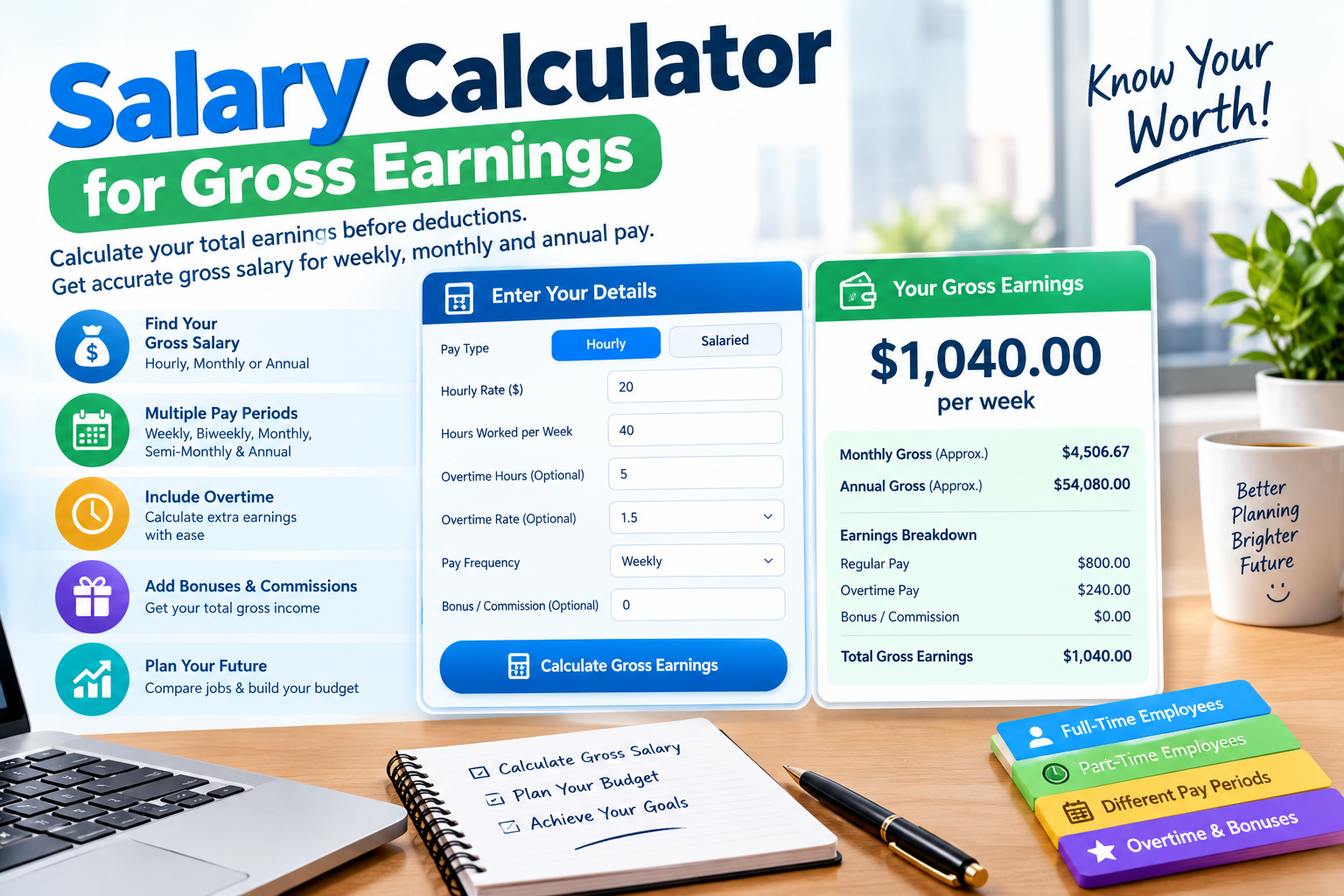
A Salary Calculator for Gross Earnings makes this process easier by helping employees estimate their gross income from different pay periods. Whether you receive an hourly wage, weekly salary, biweekly paycheck, or annual salary, a calculator can convert your earnings into useful figures.
This guide explains what gross earnings mean, how they are calculated, what information you need, and how an online calculator can help you understand your income.
Table of Contents
ToggleWhat Are Gross Earnings?
Gross earnings are the total amount of money an employee earns before deductions are removed from their paycheck. These deductions may include income taxes, retirement contributions, health insurance, Social Security, or other payroll deductions.
For salaried employees, gross earnings may be represented as an annual salary. For hourly workers, gross earnings are generally based on the number of hours worked and the hourly rate.
For example, if an employee earns $20 per hour and works 40 hours per week, their regular weekly gross earnings are:
$20 × 40 = $800
This amount is before taxes and other deductions.
A Salary Calculator for Gross Earnings can perform these calculations quickly and help users understand their income across different periods.
Why Gross Earnings Matter
Gross earnings are important because they provide a starting point for understanding your total compensation. When employers advertise a salary, the amount is usually presented before payroll deductions.
Knowing your gross income can help you:
- Compare different employment opportunities
- Estimate annual income
- Understand your paycheck
- Create a realistic budget
- Calculate overtime earnings
- Review salary increases
- Compare hourly and salaried jobs
- Plan savings goals
A Salary Calculator for Gross Earnings can make these calculations easier, especially when your income changes from one pay period to another.
How Does a Gross Earnings Calculator Work?
A calculator generally uses your pay rate, working hours, and pay frequency to estimate gross income. Depending on your employment arrangement, you may enter an hourly rate or annual salary.
For an hourly employee, the basic formula is:
Hourly Rate × Hours Worked = Gross Pay
If you work overtime, additional calculations may be required.
For a salaried employee, annual gross earnings can be divided by the number of pay periods to estimate each paycheck.
A Salary Calculator for Gross Earnings combines these calculations into a simple process, allowing users to see their estimated earnings without doing the mathematics manually.
Hourly Gross Earnings Calculation
Hourly workers can calculate gross earnings by multiplying their hourly wage by the number of hours worked.
Suppose you earn $18 per hour and work 40 hours each week.
Your weekly gross earnings would be:
$18 × 40 = $720
If you work 52 weeks in a year, the estimated annual gross earnings would be:
$720 × 52 = $37,440
This assumes the same number of hours every week and does not account for unpaid time off.
A Salary Calculator for Gross Earnings can help convert hourly earnings into weekly, monthly, and annual estimates.
Calculating Salaried Employee Earnings
Salaried employees usually receive a predetermined annual salary rather than being paid according to each individual hour worked.
For example, suppose an employee has an annual salary of $60,000.
Their approximate monthly gross earnings can be calculated as:
$60,000 ÷ 12 = $5,000
Their gross earnings per month would therefore be approximately $5,000 before deductions.
A Salary Calculator for Gross Earnings can also calculate estimates for weekly, biweekly, semi-monthly, and other pay schedules.
Gross Earnings vs. Net Earnings
One of the most important distinctions in salary calculations is the difference between gross and net earnings.
Gross earnings are the amount earned before deductions.
Net earnings are the amount left after applicable deductions have been removed.
For example, an employee may have gross earnings of $4,000 for a month. After taxes, insurance, retirement contributions, and other deductions, the employee might receive a smaller amount in their bank account.
A Salary Calculator for Gross Earnings focuses on the income earned before these deductions.
Understanding this difference can prevent confusion when comparing an advertised salary with the amount shown on a paycheck.
Gross Pay and Taxes
Taxes can significantly affect the amount an employee takes home. However, taxes are generally calculated after determining gross earnings.
Your gross pay provides a starting point for determining taxable income, although not every dollar of gross compensation is necessarily treated the same way for tax purposes.
Tax rules vary by country, state, province, and individual circumstances. Therefore, a calculator that estimates gross earnings should not automatically be treated as a tax calculator.
A Salary Calculator for Gross Earnings is primarily useful for understanding your total pay before payroll deductions.
Gross Earnings for Different Pay Periods
Employees may receive their salaries on different schedules. Common pay periods include:
- Weekly
- Biweekly
- Semi-monthly
- Monthly
- Annually
The same annual salary can produce different paycheck amounts depending on the number of payments made during the year.
For example, a $52,000 annual salary could be divided into 52 weekly payments, 26 biweekly payments, 24 semi-monthly payments, or 12 monthly payments.
A Salary Calculator for Gross Earnings can help users compare these pay periods and understand how much gross income corresponds to each schedule.
Overtime and Gross Earnings
Overtime can increase gross earnings for employees who are eligible for overtime pay.
Suppose an employee earns $20 per hour and works 45 hours in a week. If five hours qualify for overtime at a rate of 1.5 times the regular hourly rate, the overtime rate would be:
$20 × 1.5 = $30 per hour
The regular earnings for 40 hours would be:
40 × $20 = $800
The overtime earnings would be:
5 × $30 = $150
Total gross earnings would be:
$800 + $150 = $950
A Salary Calculator for Gross Earnings can be useful when estimating income that includes overtime, provided the calculator supports overtime inputs.
Bonuses and Additional Compensation
Gross earnings may include more than a regular salary or hourly wage. Depending on the employer and compensation structure, employees may receive bonuses, commissions, shift differentials, or other forms of compensation.
For example, an employee with a $50,000 annual salary may receive a $3,000 performance bonus. If the bonus is included in gross compensation, total earnings for the year could reach $53,000 before applicable deductions.
A Salary Calculator for Gross Earnings can help users estimate total compensation when additional earnings are included.
However, bonuses may be handled differently for tax and payroll purposes, so employees should review their payslips and employer documentation.
Why Use an Online Salary Calculator?
Manual salary calculations can become complicated when you have multiple pay rates, overtime hours, bonuses, or different pay periods.
An online calculator can provide several advantages:
Faster Calculations
You can enter your information and receive an estimate quickly.
Fewer Mathematical Errors
The calculator performs the basic calculations automatically.
Multiple Pay Periods
You can compare weekly, monthly, and annual earnings.
Easy Budget Planning
Knowing your gross income helps provide a starting point for financial planning.
Salary Comparison
You can compare different job offers using consistent income calculations.
A Salary Calculator for Gross Earnings is particularly useful when you want a quick estimate without creating your own spreadsheet.
Information Needed to Calculate Gross Earnings
The information required depends on how you are paid.
For hourly employees, you may need:
- Hourly wage
- Regular hours worked
- Overtime hours
- Overtime rate
- Bonuses or additional pay
For salaried employees, you may only need:
- Annual salary
- Pay frequency
- Additional compensation, if applicable
Having accurate information produces a more useful estimate.
A Salary Calculator for Gross Earnings can simplify this information by organizing the required inputs into a clear calculation.
How to Use a Salary Calculator
Using a salary calculator is generally straightforward.
Step 1: Enter Your Pay Rate
Enter your hourly wage or annual salary.
Step 2: Enter Working Hours
If you are paid hourly, enter your typical working hours.
Step 3: Add Overtime
If applicable, include overtime hours and the correct overtime rate.
Step 4: Select Your Pay Frequency
Choose weekly, biweekly, monthly, or annual calculations.
Step 5: Add Additional Earnings
Include bonuses or commissions if the calculator supports them.
Step 6: Review Your Result
The calculator will provide an estimated gross income based on the information entered.
A Salary Calculator for Gross Earnings can make each of these steps easier by providing an organized way to calculate your income.
Gross Earnings for Part-Time Employees
Part-time employees may work different numbers of hours each week, making income estimation more difficult.
For example, an employee earning $16 per hour who works 25 hours per week would have regular weekly gross earnings of:
$16 × 25 = $400
If the schedule remains consistent for 52 weeks, estimated annual gross earnings would be:
$400 × 52 = $20,800
A Salary Calculator for Gross Earnings can help part-time workers estimate their income based on their typical weekly schedule.
Gross Earnings for Full-Time Employees
Full-time employees often have more predictable working schedules. However, their gross earnings can still vary because of overtime, bonuses, commissions, or unpaid leave.
An employee earning $25 per hour and working 40 hours per week would have regular weekly earnings of $1,000.
Estimated annual earnings at 52 weeks would be:
$1,000 × 52 = $52,000
This is a gross estimate before deductions.
A Salary Calculator for Gross Earnings can help full-time employees understand these figures and compare them with alternative job opportunities.
Comparing Job Offers
When comparing job offers, looking only at the headline salary may not provide the complete picture.
Employees should also consider:
- Hourly or annual compensation
- Expected working hours
- Overtime opportunities
- Bonuses
- Benefits
- Paid time off
- Retirement contributions
- Insurance
- Work schedule
A Salary Calculator for Gross Earnings can provide a consistent way to compare the basic earnings component of different offers.
For example, one job may offer a higher annual salary but require significantly more working hours. Another may offer a lower salary but include additional benefits.
Common Mistakes in Gross Salary Calculations
Several common mistakes can lead to incorrect estimates.
One mistake is forgetting to account for the number of weeks actually worked. Another is confusing biweekly pay with twice-monthly pay. These are not always the same because biweekly pay generally results in 26 payments per year, while semi-monthly pay normally results in 24.
Another mistake is including overtime incorrectly or forgetting bonuses.
Using a Salary Calculator for Gross Earnings can reduce these errors when the correct information is entered.
Gross Earnings and Financial Planning
Gross earnings are useful for understanding your total compensation, but personal budgets are often based on net income.
For this reason, employees should distinguish between gross and take-home pay when creating a financial plan.
Gross income can still be useful for:
- Comparing salaries
- Understanding compensation
- Estimating annual earnings
- Reviewing salary increases
- Planning career moves
A Salary Calculator for Gross Earnings gives users a clear starting point before they consider taxes and other deductions.
Can Gross Earnings Change?
Yes. Gross earnings can change for many reasons.
An employee may receive a raise, work additional hours, earn overtime, receive a bonus, or change jobs. Part-time workers may also experience changes because of variations in their schedules.
For example, an employee’s normal weekly earnings may be $800, but overtime could increase one week’s gross earnings to $1,000.
A Salary Calculator for Gross Earnings can help users recalculate their income whenever their pay or working schedule changes.
Tips for Getting Accurate Results
For the most useful salary estimate, make sure your information is accurate.
Check your hourly rate or annual salary carefully. Confirm your regular working hours and overtime rate. Select the correct pay frequency. If you receive bonuses or commissions, include them when appropriate.
You should also understand whether the calculator is showing gross earnings only or whether it includes additional calculations for deductions and taxes.
A Salary Calculator for Gross Earnings is most effective when users enter realistic and up-to-date information.
Final Thoughts
Gross earnings provide an important view of your total compensation before deductions. Whether you are an hourly worker, salaried employee, part-time worker, or full-time professional, understanding gross pay can help you make better financial and career decisions.
A Salary Calculator for Gross Earnings provides a convenient way to estimate your income across different pay periods. It can help you calculate weekly, biweekly, monthly, and annual earnings while also considering overtime and additional compensation when supported.
Remember that gross earnings are not the same as take-home pay. Taxes, insurance, retirement contributions, and other deductions may reduce the amount you actually receive. Tax rules and payroll requirements also vary depending on your location and personal circumstances.
For the best results, use accurate salary information, working hours, overtime details, and pay frequency. Then use your calculated gross earnings as a starting point for budgeting, salary comparisons, career planning, and understanding your overall compensation.
With the right information, a Salary Calculator for Gross Earnings can turn complicated salary calculations into a simple and practical process.
One Response