
A Salary Difference Calculator is a useful online tool that helps you compare two salaries and understand the exact difference between them. Whether you are comparing a current salary with a new job offer, checking the impact of a raise, or simply reviewing income changes, a salary difference calculator can make the process quick and simple.
Instead of calculating the difference manually, you can enter two salary amounts and instantly see how much higher or lower one salary is compared with the other. This can be especially helpful when making career and financial decisions.
What Is a Salary Difference Calculator?
A Salary Difference Calculator is designed to calculate the gap between two income amounts. For example, if your current annual salary is $40,000 and a new job offers $48,000, the calculator can show that the difference is $8,000 per year.
Many calculators can also help you understand the difference on a monthly, weekly, or hourly basis. This gives you a clearer picture of how a salary change may affect your regular income.
How Does a Salary Difference Calculator Work?
Using a Salary Difference Calculator is usually very easy. You normally enter your current salary and your new or comparison salary. The tool then subtracts the lower amount from the higher amount.
For example:
New Salary: $50,000
Current Salary: $45,000
Salary Difference: $5,000
If you also want to know the percentage increase, you can calculate it using the original salary as the starting point. In this example, the $5,000 difference represents an increase of about 11.11% over the $45,000 salary.
Why Compare Two Salaries?
Comparing salaries can help you make better financial and career decisions. When you receive a new job offer, the headline salary may look attractive, but it is important to understand exactly how much more you would earn.
A salary comparison can also help when negotiating a raise. If you know the difference between your current earnings and the amount you believe your role is worth, you can approach a salary discussion with clearer information.
Salary Difference vs. Salary Increase
A salary difference and a salary increase are related but not exactly the same. Salary difference simply tells you the numerical gap between two salaries. A salary increase usually refers to an improvement from an original salary to a new salary.
For example, moving from $40,000 to $45,000 creates a $5,000 salary difference. Because the new amount is higher, it can also be described as a $5,000 salary increase.
Understanding both figures can give you a better idea of how significant a pay change really is.
Calculate Salary Difference by Month
Annual salaries can sometimes be difficult to compare because most people manage their everyday expenses on a monthly basis. Converting the salary difference into a monthly amount can make the comparison easier.
For example, a $6,000 annual salary difference equals approximately $500 per month before taxes when divided by 12 months.
This simple calculation can help you consider whether a new salary is enough to justify changes such as commuting costs, relocation, or additional work responsibilities.
Calculate Salary Difference by Hour
Hourly comparisons can also be useful when two jobs have different working schedules. A higher annual salary does not always mean a better hourly earning rate if one position requires significantly more working hours.
To estimate an hourly salary, you can divide annual earnings by the number of working hours in a year. The exact result depends on your work schedule and the number of hours you work.
This makes a Salary Difference Calculator particularly useful when comparing full-time positions with different working arrangements.
Benefits of Using a Salary Difference Calculator
A Salary Difference Calculator can save time and reduce calculation mistakes. Some of its main benefits include:
- Quickly comparing two salaries
- Understanding annual income differences
- Estimating monthly income changes
- Supporting salary negotiations
- Comparing job offers
- Understanding the impact of a raise
- Making financial planning easier
The tool is especially helpful when you need a quick estimate without performing several calculations manually.
When Should You Use a Salary Difference Calculator?
You can use a Salary Difference Calculator in many situations. Job seekers can compare a current salary with a new job offer. Employees can estimate the impact of a proposed raise. Employers and HR professionals can compare compensation levels.
Students and people planning their careers can also use salary comparisons to understand how different career paths may affect potential earnings.
Final Thoughts
A Salary Difference Calculator provides a simple way to compare two salaries and understand the financial gap between them. By looking at the difference in annual, monthly, weekly, or hourly earnings, you can get a clearer picture of a potential job change or salary increase.
Before making an important career decision, remember that salary is only one factor. Benefits, working hours, bonuses, taxes, location, commuting costs, and career growth can also affect the overall value of a job. Use a Salary Difference Calculator as a starting point to make salary comparisons faster, clearer, and easier.
Salary Difference Calculator: A Complete Guide to Comparing Salaries
A Salary Difference Calculator is a helpful tool for anyone who wants to compare two salaries quickly and accurately. Whether you are considering a new job, negotiating a raise, changing careers, or reviewing your income, comparing salaries can help you understand the financial impact of your decision. Instead of doing calculations manually, a salary calculator can provide a simple way to see the difference between two income amounts.
Salary comparisons are not always as straightforward as they seem. Two jobs may offer different annual salaries, working hours, bonuses, or benefits. For this reason, understanding the actual salary difference can be an important part of making a well-informed decision.
What Is a Salary Difference Calculator?
A Salary Difference Calculator compares two salary amounts and shows the difference between them. You can normally enter your current salary and another salary, such as a new job offer or a proposed salary after a raise.
For example, suppose your current annual salary is $42,000 and a new position offers $50,000. The difference is $8,000 per year. This means the new salary is $8,000 higher before considering taxes, benefits, bonuses, or other costs.
The calculator can make this comparison easier by providing the result instantly. Some tools may also allow you to compare salaries by month, week, day, or hour.
Why Is Salary Comparison Important?
Salary comparison is important because a small difference in annual income can become significant over several years. If you are choosing between two job opportunities, knowing the salary difference can help you understand the financial side of each option.
For example, a new position might offer a higher salary but require a longer commute. Another position may have a slightly lower salary but offer flexible working hours and better benefits. Comparing the salaries is only one part of the decision, but it gives you useful financial information.
A Salary Difference Calculator can help you identify the numerical difference before you consider other factors.
How to Calculate Salary Difference
The basic calculation is simple:
Salary Difference = Higher Salary − Lower Salary
For example:
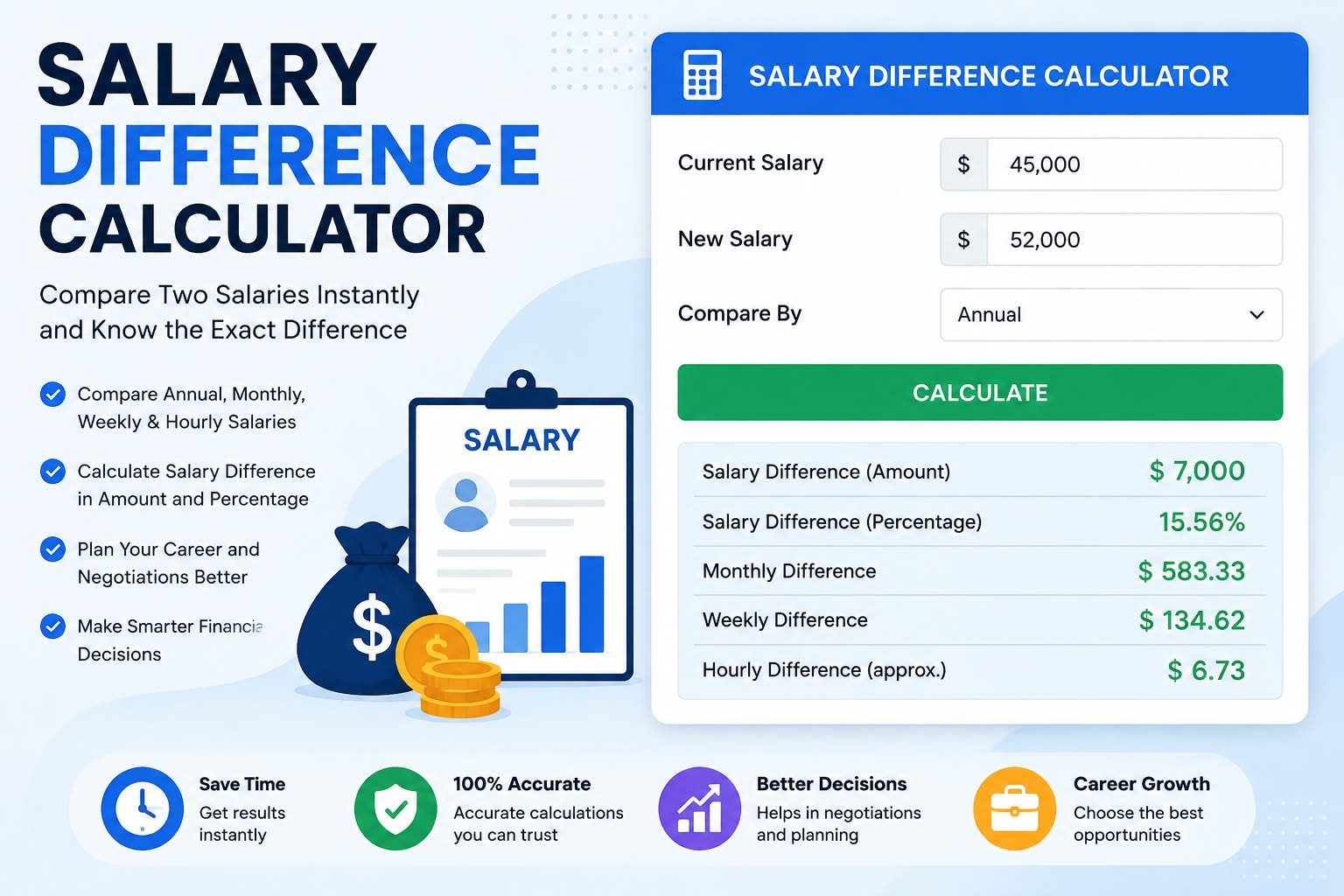
Current Salary = $45,000
New Salary = $52,000
Salary Difference = $52,000 − $45,000
Salary Difference = $7,000
The new salary is therefore $7,000 higher than the current salary.
If you want to calculate the percentage difference based on your original salary, you can use:
Salary Increase Percentage = (Salary Difference ÷ Original Salary) × 100
Using the example above:
$7,000 ÷ $45,000 × 100 = approximately 15.56%
This gives you another useful way to understand the size of the salary change.
Compare Monthly Salary Differences
Annual salary figures can sometimes feel difficult to understand because most household expenses are paid monthly. Converting the annual difference into a monthly amount can make the comparison more practical.
For example, if your annual salary increases by $6,000, dividing that amount by 12 gives approximately $500 per month before taxes.
This does not mean you will necessarily receive exactly $500 more in your monthly paycheck because taxes and deductions can affect your actual take-home pay. However, it provides a useful estimate for comparing gross income.
Compare Weekly and Hourly Earnings
A Salary Difference Calculator can also be useful for comparing weekly and hourly earnings. This becomes especially important when two jobs have different working schedules.
Imagine one job pays $48,000 annually while another pays $52,000. At first glance, the second job appears better financially. However, if the second position requires substantially more working hours, the hourly difference may be smaller than expected.
To estimate hourly income, you can divide annual salary by the approximate number of hours worked in a year. Your actual hourly rate depends on your working schedule, paid holidays, overtime, and other employment conditions.
Salary Difference When Changing Jobs
Changing jobs is one of the most common reasons people compare salaries. A new employer may offer a higher salary, but it is important to compare the complete compensation package.
Consider factors such as health benefits, bonuses, paid leave, retirement contributions, transportation costs, and working hours. A Salary Difference Calculator can tell you how much the base salaries differ, while these additional factors help you understand the broader value of each position.
Salary Difference and Pay Raises
Employees can use salary comparisons when evaluating a proposed pay raise. If your current salary is $40,000 and your new salary would be $44,000, the difference is $4,000 annually.
You can then convert the difference into a monthly estimate to better understand how the raise may affect your income.
Knowing the exact salary difference can also make salary discussions easier because you can clearly identify the change between your current and proposed compensation.
Comparing Salaries Across Careers
Salary comparison is not only useful for existing employees. People planning their careers can also compare potential salaries across different professions.
For example, someone deciding between two career paths may research typical salaries and then use a calculator to compare possible income levels. However, salary data can vary depending on experience, education, location, industry, and employer.
Therefore, salary figures should be treated as estimates rather than guarantees.
Gross Salary vs. Take-Home Salary
When comparing salaries, it is important to understand the difference between gross salary and take-home pay.
Gross salary is the amount earned before taxes and other deductions. Take-home pay is the amount that remains after deductions.
A Salary Difference Calculator generally compares the salary amounts you enter. If you want to understand your actual paycheck difference, you may also need to consider applicable taxes, insurance, retirement contributions, and other deductions.
This is especially important when a large salary increase does not result in the same amount of additional take-home pay.
Benefits of Using a Salary Difference Calculator
There are several benefits to using this type of calculator:
- It saves time.
- It reduces basic calculation errors.
- It makes salary comparisons easier.
- It can help with job-offer decisions.
- It supports salary negotiation.
- It can show the impact of a raise.
- It helps with financial planning.
- It can simplify annual-to-monthly comparisons.
Because the calculation is straightforward, an online tool can provide a quick result whenever you need it.
Tips for Making Better Salary Comparisons
When comparing salaries, do not focus only on the largest number. Look at the complete compensation package and consider your personal circumstances.
Check whether the salary includes bonuses or commissions. Compare working hours and overtime policies. Consider commuting or relocation expenses. Review paid vacation and other benefits. You should also consider opportunities for career development and future salary growth.
These factors can make a significant difference when choosing between two employment opportunities.
Final Thoughts
A Salary Difference Calculator is a simple but useful tool for comparing income levels. It can help you calculate the difference between your current salary and a new offer, estimate the impact of a raise, or compare potential earnings between different jobs.
The calculator provides the mathematical difference, but a good career decision requires more than salary alone. Taxes, benefits, working hours, location, expenses, and career opportunities should also be considered.
By combining salary calculations with careful research, you can get a clearer understanding of your earning potential and make more informed financial and career decisions.
How Does a Salary Difference Calculator Work
One Response