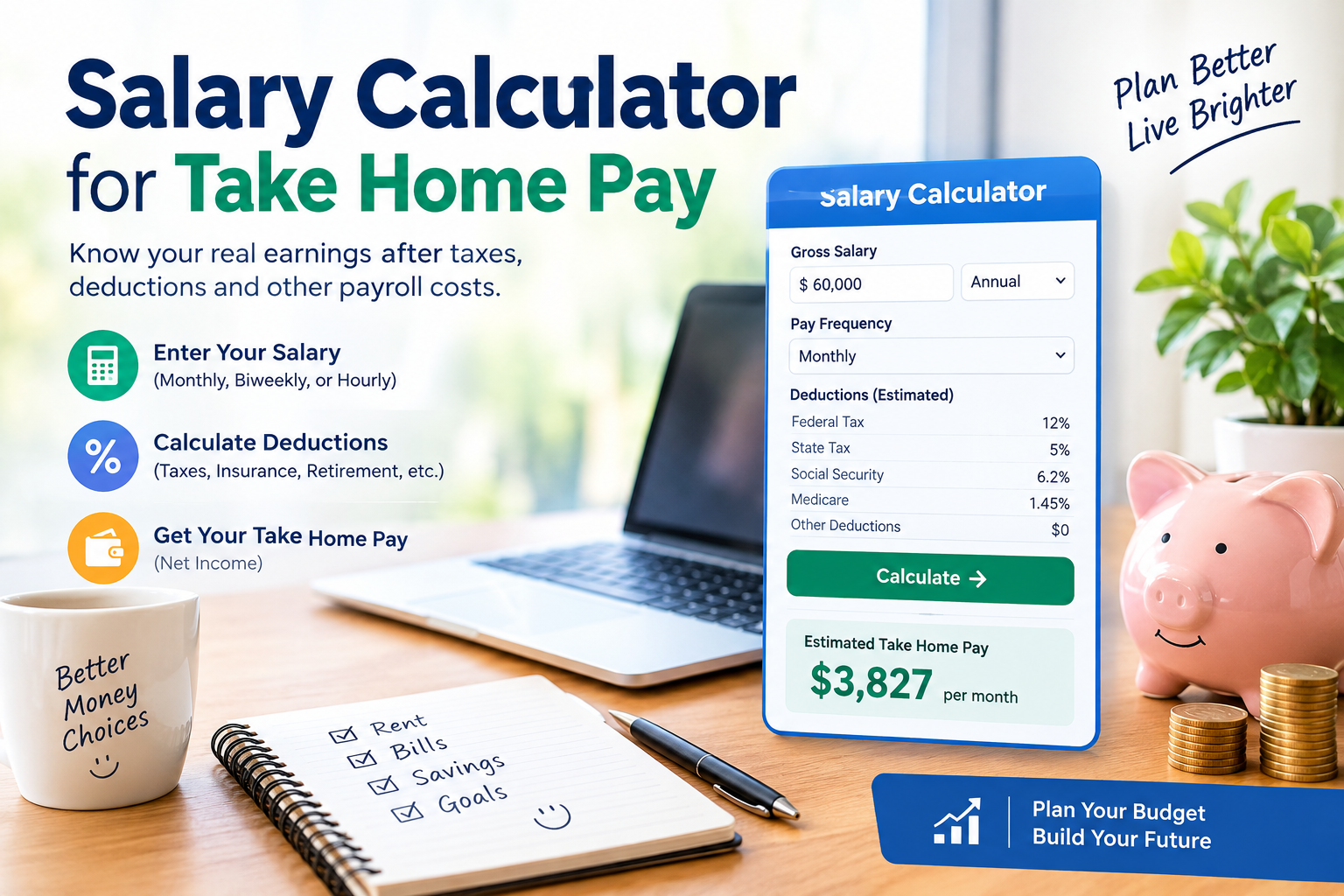
Understanding how much money you actually receive from your paycheck is important for managing your finances. Your annual salary may look attractive when you receive a job offer, but your actual take-home pay can be lower after taxes, insurance, retirement contributions, and other deductions. A Salary Calculator for Take Home Pay can help you estimate the amount of money you may receive after common deductions.
Whether you are starting a new job, comparing employment offers, planning a monthly budget, or simply trying to understand your paycheck, knowing your estimated net income can make financial planning easier. Instead of looking only at your gross salary, you can use a Salary Calculator for Take Home Pay to get a clearer idea of your potential earnings.
Table of Contents
ToggleWhat Is Take-Home Pay?
Take-home pay is the amount of money you receive after deductions have been taken from your gross earnings. It is sometimes called net pay or net salary. Your gross salary represents your earnings before deductions, while take-home pay represents the amount that is actually available to you.
Common deductions can include federal and state taxes, Social Security, Medicare, retirement contributions, health insurance premiums, and other payroll deductions. The exact deductions depend on your location, employment situation, income level, Calculate your real earnings with our Salary Calculator for Take Home Pay. Estimate net income after taxes, deductions, insurance, and other payroll expenses. and benefits.
A Salary Calculator for Take Home Pay helps turn your gross income into an estimated net amount. This can be especially useful when you want to know how much you could have available each week, every two weeks, or each month.
Why Take-Home Pay Matters
Gross salary is useful when comparing job offers, but it does not always show your real spending power. Two jobs with similar salaries can result in different take-home amounts because of differences in taxes, benefits, retirement plans, or other deductions.
Using a Salary Calculator for Take Home Pay can help you understand the difference between your advertised salary and your estimated net earnings.
This information can help with everyday financial decisions. For example, if you are planning to rent a home, purchase a vehicle, save for a goal, or manage household expenses, your net income is often more useful than your gross salary.
How a Salary Calculator Works
A salary calculator generally starts with your gross income. You enter information such as your salary, pay frequency, location, and other relevant details. The calculator then estimates common deductions to provide an approximate take-home amount.
A Salary Calculator for Take Home Pay may consider several factors, including:
- Gross annual salary
- Hourly wage
- Number of working hours
- Pay frequency
- Federal income tax
- State or local taxes
- Social Security contributions
- Medicare contributions
- Retirement contributions
- Health insurance deductions
The calculation provides an estimate rather than a guaranteed paycheck amount. Actual payroll results can vary because employers and tax authorities may use different rules and deductions.
Gross Pay vs. Net Pay
Gross pay and net pay are two important terms to understand.
Gross pay is your total earnings before deductions. If your annual salary is $60,000, that amount represents your gross annual income.
Net pay is the amount left after applicable deductions. If taxes and other deductions reduce your earnings, the amount deposited into your bank account may be significantly lower than your gross pay.
A Salary Calculator for Take Home Pay makes this difference easier to understand by showing an estimated amount after deductions.
Understanding both figures can help you make better employment and budgeting decisions.
Factors That Affect Take-Home Pay
Several factors can influence how much of your salary you actually receive. One of the biggest factors is your tax situation. Tax rates and rules can vary depending on where you live and your income level.
Your filing status may also affect your tax calculation. In addition, benefits such as health insurance and retirement contributions can reduce the amount of money included in your regular paycheck.
Pay frequency is another important factor. Someone paid weekly will receive smaller individual payments more frequently, while someone paid monthly may receive larger but less frequent payments.
When you use a Salary Calculator for Take Home Pay, entering accurate information can make the estimate more useful.
Calculating Take-Home Pay From an Annual Salary
Suppose you receive an annual salary of $60,000. Your employer does not necessarily pay the full $60,000 directly to you. Instead, deductions are normally taken from your earnings throughout the year.
For example, if you are paid monthly, your gross monthly income before deductions would be approximately $5,000. After taxes and other deductions, your actual monthly payment would be lower.
A Salary Calculator for Take Home Pay can estimate the amount remaining after applicable deductions, helping you understand your expected monthly income.
The same annual salary can also be converted into weekly, biweekly, or other pay periods depending on how often you are paid.
Hourly Workers and Take-Home Pay
Salary calculators are not only useful for salaried employees. Hourly workers can also estimate their take-home earnings.
To calculate gross income from an hourly wage, you generally need to know your hourly rate and the number of hours worked. Overtime, bonuses, commissions, and changing work schedules can make the calculation more complicated.
For example, an employee earning $25 per hour and working 40 hours per week has a regular weekly gross income of $1,000 before deductions. Taxes and other payroll deductions would reduce the final amount received.
A Salary Calculator for Take Home Pay can help hourly workers estimate their net earnings and compare different wage opportunities.
Using Take-Home Pay for Budgeting
Your take-home pay is one of the most important numbers when creating a personal budget. Your budget should generally be based on the money you expect to have available rather than your gross salary.
You can divide your estimated net income among categories such as housing, food, transportation, savings, education, utilities, and entertainment.
If you know your approximate take-home amount, it becomes easier to decide how much you can reasonably spend and save.
A Salary Calculator for Take Home Pay can therefore be useful before creating or updating a monthly budget.
Comparing Job Offers
When comparing two employment opportunities, salary should not be the only factor you consider. A job with a higher gross salary may not always provide the highest take-home pay.
For example, one employer may offer a higher salary but charge more for health insurance. Another employer may provide better retirement benefits or lower employee deductions.
Using a Salary Calculator for Take Home Pay can help you estimate how much money you may actually receive from each offer.
You should also consider paid time off, bonuses, retirement benefits, insurance, commuting costs, and other employment benefits when comparing opportunities.
Take-Home Pay and Taxes
Taxes are one of the main reasons your net income differs from your gross salary. Depending on your location and circumstances, your paycheck may include several different tax-related deductions.
Tax rules can change over time, and individual circumstances can make calculations different from one employee to another. For this reason, calculator results should be treated as estimates.
A Salary Calculator for Take Home Pay can provide a convenient starting point, but it should not replace official tax information or professional tax advice.
For the most accurate tax information, employees should check current government guidance and their payroll documents.
How Often Should You Calculate Your Take-Home Pay?
You may want to calculate your take-home pay whenever your income or deductions change. This could happen after receiving a promotion, changing jobs, moving to another location, changing benefits, or adjusting retirement contributions.
It can also be helpful to review your estimated net income when creating a new budget.
A Salary Calculator for Take Home Pay can make these calculations faster and easier, especially when you want to compare different salary or pay-period scenarios.
Benefits of Using an Online Salary Calculator
Online calculators can save time because they perform calculations automatically. Instead of manually estimating different deductions, you can enter your information and receive an estimated result quickly.
A Salary Calculator for Take Home Pay can also make salary information easier to understand by presenting gross income, deductions, and estimated net income in one place.
Other benefits include:
- Quick salary estimates
- Easy comparison of pay periods
- Better budgeting information
- Helpful job-offer comparisons
- Simple gross-to-net calculations
- Convenient online access
The more accurate your input information is, the more useful the estimate is likely to be.
Tips for Getting a Better Estimate
Before using a calculator, collect the information you need. Check your employment contract, recent paycheck, benefits information, and tax details if available.
Enter your gross salary or hourly wage carefully. Select the correct pay frequency and provide accurate location information where required.
You should also include relevant deductions such as retirement contributions or insurance premiums when the calculator supports them.
Remember that a Salary Calculator for Take Home Pay provides an estimate. Your actual paycheck can be different because payroll systems may include additional deductions, benefits, taxes, or adjustments.
Final Thoughts
Knowing your take-home pay can make salary information much more practical. Gross salary tells you what you earn before deductions, while net pay gives you a better idea of the money available for everyday expenses and financial goals.
A Salary Calculator for Take Home Pay can help employees, hourly workers, job seekers, and anyone planning a budget estimate their potential net income. By considering salary, pay frequency, taxes, and common deductions, you can get a clearer picture of your expected earnings.
Before making major financial decisions, always verify your actual paycheck, employer information, and applicable tax rules. Calculator results are useful for planning, but your real payroll statement remains the best source for your final take-home amount.
With a clear understanding of gross pay, deductions, and net income, you can make more informed decisions about jobs, budgets, savings, and your overall financial planning.
How Does a Salary Calculator for Take Home Pay Work?