
Table of Contents
ToggleIntroduction to Salary Calculator for Shift Workers
Working shifts is common in industries such as healthcare, manufacturing, transportation, retail, hospitality, and customer support. Employees in these fields may work during the day, evening, overnight, or on rotating schedules. Their earnings can vary depending on working hours, overtime, weekend duties, and additional shift allowances.
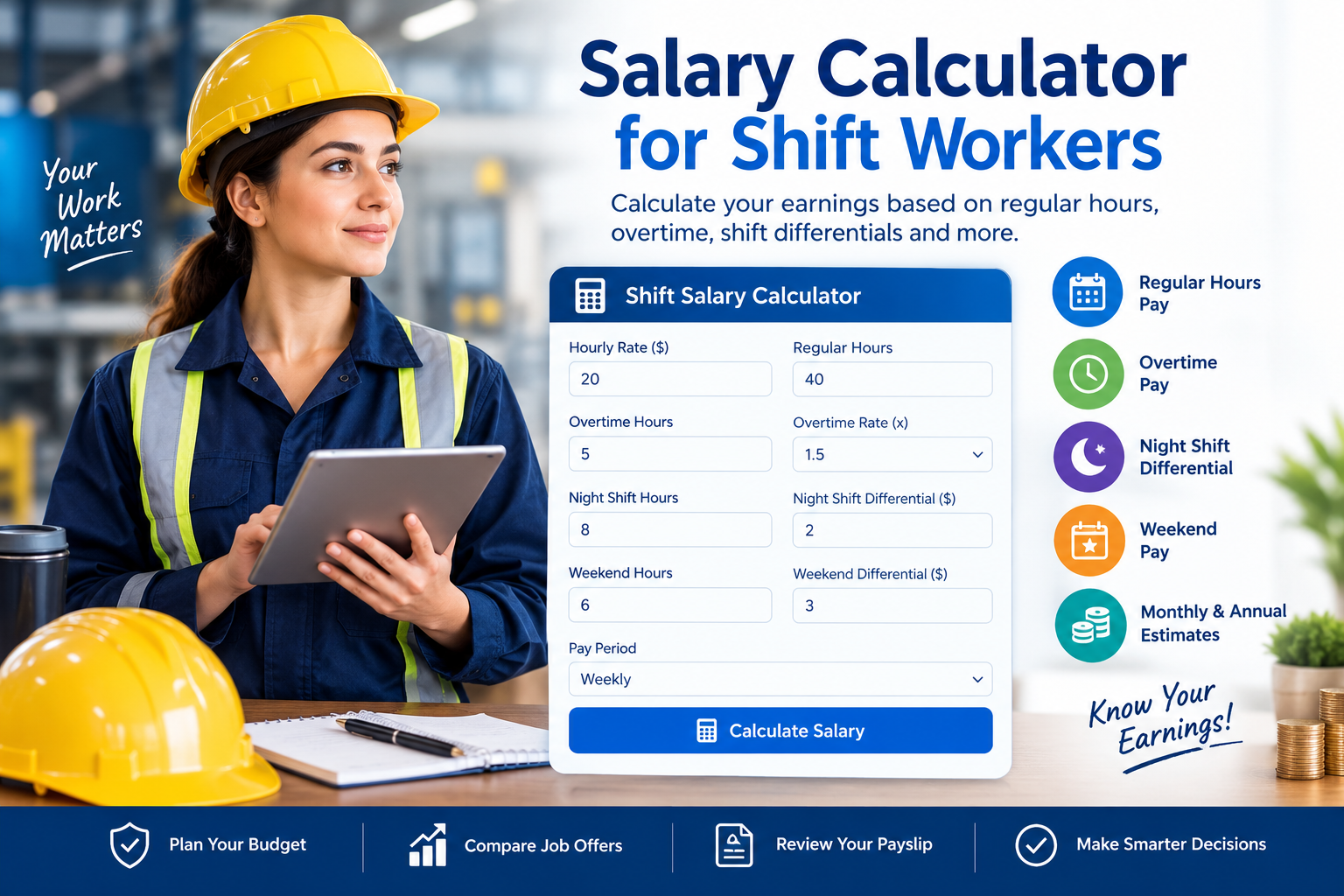
A Salary Calculator for Shift Workers helps employees estimate their Salary Calculator for Shift Workers earnings based on their hourly rate, scheduled hours, overtime, and applicable shift differentials. Instead of calculating every shift manually, workers can organize their working hours and develop a clearer understanding of their expected income.
Shift workers may receive different pay rates depending Salary Calculator for Shift Workers on when they work. For example, an employer might provide an additional allowance for overnight shifts or pay a higher rate for eligible overtime hours. These arrangements depend on employment contracts, company policies, and local labor laws.
Understanding your pay can help you review your payslip, plan household expenses, and compare work schedules. This guide explains how a Salary Calculator for Shift Workers works, which factors affect earnings, and how to estimate weekly, monthly, and annual income.
What Is a Salary Calculator for Shift Workers?
A Salary Calculator for Shift Workers is a calculation tool designed to estimate earnings for employees who work nontraditional schedules. It can help users organize regular hours, overtime, shift premiums, and other applicable pay components.
Unlike a basic salary calculator, a shift-focused calculator can account for changes in working hours and pay rates across different shifts.
For example, an employee might work regular daytime hours on Monday, an evening shift on Wednesday, and an overnight shift on Friday. If the employer pays Salary Calculator for Shift Workers different rates for these shifts, the employee needs to calculate each category separately.
A shift salary calculator can help users:
- Estimate gross earnings for each shift.
- Calculate weekly and monthly income.
- Include eligible overtime payments.
- Estimate additional shift allowances.
- Compare different work schedules.
- Review expected earnings before deductions.
The result is an estimate rather than a guaranteed paycheck. Actual earnings depend on the employer’s payroll rules, approved hours, applicable laws, and other compensation arrangements.
Why Shift Workers Need a Salary Calculator
Shift work can make income calculations more Salary Calculator for Shift Workers complicated because employees do not always work the same number of hours every day.
Some workers have fixed schedules, while others receive different shifts each week. Rotating schedules can also change the number of evening, overnight, weekend, and overtime hours worked during a pay period.
A Salary Calculator for Shift Workers helps simplify these calculations.
Better Understanding of Earnings
When employees know their hourly rate and scheduled hours, they can estimate their regular wages. Adding eligible overtime and shift premiums gives them a more complete picture of their gross income.
Easier Budget Planning
Workers often need to plan rent, transportation, groceries, utilities, and savings around their paydays. An income estimate can help them organize expenses and prepare for weeks when fewer shifts are available.
Improved Payslip Reviews
Comparing estimated earnings with a payslip can help Salary Calculator for Shift Workers employees identify questions about missing hours, incorrect rates, or unexplained deductions.
A difference does not automatically mean there is an error. Payroll cut-off dates, unpaid breaks, taxes, and adjustments can affect the final amount.
Comparing Job Opportunities
Some employers offer higher hourly rates, while others provide shift allowances, overtime opportunities, or more consistent schedules. A calculator can help workers compare these compensation structures.
How to Calculate Shift Worker Salary
The basic calculation starts with regular hours and the applicable hourly wage.
Regular Pay = Regular Hours × Hourly Rate
Additional earnings can then be added where applicable.
Gross Pay = Regular Pay + Overtime Pay + Shift Differentials + Other Earnings
For example, suppose an employee works Salary Calculator for Shift Workers 40 regular hours at $20 per hour.
Regular pay = 40 × $20 = $800.
If the employee also earns $60 in qualifying shift differentials and $150 in eligible overtime compensation, the estimated gross pay is:
Gross pay = $800 + $60 + $150 = $1,010.
This is an illustrative example, not a universal overtime formula. Overtime calculations depend on the applicable legal rules and employment arrangements. The example assumes that the additional amounts are calculated correctly and are not already included in regular pay.
Understanding Regular Shift Pay
Regular shift pay is the amount employees earn for their ordinary working hours.
To calculate regular pay, identify three essential details:
- The employee’s hourly wage.
- The total number of regular paid hours.
- Any unpaid breaks or other adjustments that affect paid time.
For example, an employee earns $18 per hour and works 35 paid hours during a week.
Regular pay = 35 × $18 = $630.
If the employee works the same paid hours each week, this amount provides a starting point for estimating income over a longer period.
However, weekly hours may change because of holidays, absences, schedule adjustments, or additional shifts. Employees should use their actual paid hours when preparing a more precise estimate.
Calculating Night Shift Pay
Night shifts are common in hospitals, warehouses, factories, security services, and customer support centers.
Some employers pay the same hourly rate for all shifts. Others provide an additional night shift differential to compensate employees for working during designated hours.
For example, assume an employee works 24 night-shift hours at a regular rate of $20 per hour. The employer provides an additional $2 per hour for eligible night hours.
Regular night-shift pay = 24 × $20 = $480.
Night shift differential = 24 × $2 = $48.
Total earnings for those hours = $480 + $48 = $528.
The additional payment is only applicable if the employer’s policy or relevant agreement provides for it. Night work does not automatically qualify for a premium in every location.
A Salary Calculator for Shift Workers makes it easier to separate regular earnings from additional shift payments.
How to Calculate Overtime Pay
Overtime occurs when an employee works hours that qualify for additional compensation under applicable law or an employment agreement.
The rules may depend on the country, state, industry, employee classification, and number of hours worked during a defined period.
For an illustrative calculation, assume an employee earns Salary Calculator for Shift Workers $20 per hour and qualifies for overtime at 1.5 times the regular rate.
Overtime rate = $20 × 1.5 = $30 per hour.
If the employee has five qualifying overtime hours:
Overtime pay = 5 × $30 = $150.
Some payroll systems calculate overtime using specific workweeks, while other arrangements may follow different legal requirements. Employers may also need to include certain additional earnings when determining the applicable regular rate.
For reliable information about US federal overtime rules, visit the official U.S. Department of Labor website:
Weekend and holiday work is common in healthcare, retail, hospitality, logistics, and emergency services.
Some employers offer extra compensation for working on Saturdays, Sundays, or designated holidays. Others pay the ordinary rate unless a specific policy or law requires additional compensation.
Suppose an employee works eight eligible Salary Calculator for Shift Workers weekend hours at $22 per hour and receives an additional $3 per hour.
Regular weekend pay = 8 × $22 = $176.
Weekend premium = 8 × $3 = $24.
Total weekend earnings = $176 + $24 = $200.
This example assumes the additional payment applies to all eight hours and does not overlap with another premium already included in the calculation.
A calculator can help workers separate weekend earnings from regular wages and compare schedules with different compensation arrangements.
Weekly, Monthly, and Annual Salary Estimates
Shift workers may receive pay weekly, every two weeks, twice monthly, or monthly. Converting earnings between these periods helps employees understand their overall income.
Weekly Salary
Weekly salary is calculated using the total paid hours and earnings for a particular week.
If an employee earns $900 in gross wages Salary Calculator for Shift Workers during a week, the weekly gross estimate is $900.
Biweekly Salary
A biweekly payroll covers two weeks.
If the employee earns an average of $900 per week, estimated biweekly gross pay is:
$900 × 2 = $1,800.
Actual pay may vary when hours, overtime, or allowances change.
Monthly Salary
To convert average weekly earnings into an approximate monthly amount, multiply by 52 and divide by 12.
Monthly estimate = Weekly earnings × 52 ÷ 12.
Using $900 per week:
$900 × 52 ÷ 12 = $3,900.
This calculation estimates average monthly gross earnings. It does not mean every month contains exactly four workweeks.
Annual Salary
Annual gross earnings can be estimated by multiplying average weekly earnings by 52.
Annual estimate = $900 × 52 = $46,800.
This estimate assumes the employee maintains a similar earning pattern throughout the year. Unpaid leave, reduced hours, changes in overtime, and employment interruptions may change the actual total.
Gross Pay vs. Net Pay for Shift Workers
Gross pay is the amount earned before deductions. Net pay is the amount received after applicable deductions.
Common deductions may include:
- Income tax withholding.
- Social Security and Medicare taxes in the United States, where applicable.
- Pension or retirement contributions.
- Health insurance premiums.
- Other authorized deductions.
The exact deductions depend on the employee’s location, Salary Calculator for Shift Workers personal circumstances, and payroll arrangements.
For example, an employee with $1,000 in gross pay might receive a lower take-home amount after deductions. The difference cannot be calculated accurately without the relevant tax and payroll information.
A Salary Calculator for Shift Workers can estimate gross earnings and may provide take-home estimates if it supports the appropriate location-specific tax rules. For accurate payroll planning, verify the assumptions and use current official guidance.
How to Use a Salary Calculator for Shift Workers
Using a calculator becomes easier when you gather the necessary information before starting.
Step 1: Enter Your Hourly Rate
Enter the standard hourly wage specified in your employment agreement or payroll record.
If you receive different rates for different shifts, record each applicable rate separately.
Step 2: Add Your Regular Hours
Enter the total paid hours worked during the selected period. Account for unpaid breaks and any schedule adjustments.
Step 3: Enter Shift Differentials
Add any eligible night, weekend, or other shift premiums Salary Calculator for Shift Workers that are not already included in the hourly rate.
Step 4: Add Overtime Hours
Enter overtime hours separately and use the correct overtime rules for your employment situation.
Avoid counting the same hours as both regular hours and additional hours when the calculator requires separate entries.
Step 5: Select the Pay Period
Choose weekly, biweekly, monthly, or annual calculations, depending on the calculator’s available options.
Step 6: Review the Estimated Result
Check the calculated earnings and confirm that the hourly rate, hours, premiums, and overtime assumptions are correct.
Remember that the result may represent gross income rather than take-home pay.
Common Salary Calculation Mistakes
Even simple calculations can become inaccurate when Salary Calculator for Shift Workers information is entered incorrectly.
Counting Unpaid Breaks as Paid Hours
An employee’s scheduled time at work may differ from the number of paid hours. Check the applicable break policy and payroll records.
Applying the Wrong Overtime Rate
Overtime rules vary by jurisdiction and employment classification. Do not assume that the same multiplier applies to every employee.
Forgetting Shift Premiums
Employees may overlook eligible additional payments for night or weekend shifts. Review the employer’s compensation policy.
Counting Premiums Twice
If a calculator’s hourly rate already includes a shift differential, adding the same premium again can overstate earnings.
Confusing Gross and Net Pay
Gross earnings are not the same as the final paycheck. Taxes, insurance, retirement contributions, and other deductions may reduce take-home income.
Tips for Managing Income as a Shift Worker
Good income planning can make changing work schedules easier Salary Calculator for Shift Workers to manage.
First, maintain a record of scheduled and completed hours. Include overtime, approved additional shifts, and any applicable allowances.
Second, review your payslip after each pay period. Compare recorded hours with your own records and ask payroll staff about unclear differences.
Third, create a budget using realistic average earnings rather than assuming every week will include overtime. This can help when additional shifts are irregular.
Fourth, keep emergency savings in mind when planning your expenses. If your earnings vary, consider essential bills and regular costs before committing to optional spending.
Finally, compare job offers using total compensation rather than hourly pay alone. Benefits, commuting expenses, shift schedules, paid leave, and schedule reliability may all affect the overall value of a position.
Frequently Asked Questions
1. What Is a Salary Calculator for Shift Workers?
It is a tool that estimates earnings from regular working hours Salary Calculator for Shift Workers, hourly rates, overtime, and applicable shift differentials.
2. Can I Calculate Night Shift Salary?
Yes. Enter the hours worked at night, the applicable hourly rate, and any night shift premium provided by your employer.
3. Does Every Night Shift Pay More?
No. Additional night-shift compensation depends on employer policies, employment agreements, and applicable laws.
4. How Can I Estimate My Monthly Shift Salary?
Calculate your average weekly gross earnings and multiply by 52, then divide by 12. Use actual payroll information when available for greater accuracy.
5. Can a Shift Salary Calculator Include Overtime?
Yes, if the calculator supports overtime entries. You must use the appropriate overtime rate and rules for your employment situation.
6. Is Estimated Salary the Same as Take-Home Pay?
No. Estimated gross salary is calculated before deductions. Take-home pay is the amount remaining after applicable deductions.
7. Can I Use a Salary Calculator for Rotating Shifts?
Yes. Calculate each shift category separately when hours or pay rates differ, then combine the results for the relevant pay period.
8. Why Does My Payslip Differ from My Calculation?
Differences may result from payroll cut-off dates, unpaid breaks, taxes, deductions, overtime rules, or adjustments. Compare the figures and contact your payroll department if something remains unclear.
Conclusion
A Salary Calculator for Shift Workers is a practical tool for understanding income across day, evening, night, weekend, and rotating schedules. By entering accurate hours and pay rates, employees can estimate regular wages, eligible overtime, shift premiums, and gross earnings.
The calculator can also help workers convert weekly income into monthly or annual estimates, compare employment opportunities, and review their payslips more confidently.
For the most useful results, verify your hourly rate, paid hours, shift allowances, and overtime rules. Remember that the final paycheck depends on applicable deductions and payroll policies.
Whether you work in healthcare, manufacturing, transportation, retail, or another shift-based industry, careful salary calculations can support better budgeting and more informed employment decisions.
One Response