
Working extra hours can increase your paycheck, but figuring out exactly how much overtime pay you should receive is not always simple. Your regular hourly wage, total hours worked, overtime multiplier, and local employment rules can all affect the final amount. This is where an Overtime Calculator can be extremely useful.
An Overtime Calculator helps you estimate your overtime earnings without having to perform every calculation manually. Whether you are an hourly employee checking your expected paycheck, an employer estimating payroll costs, or simply planning your monthly income, the calculator can give you a quick and easy estimate.
In this guide, we will explain what overtime pay is, how overtime calculations work, how to calculate time-and-a-half, and how an Overtime Calculator can help you better understand your earnings.
Table of Contents
ToggleWhat Is an Overtime Calculator?
An Overtime Calculator is an online tool designed to estimate how much additional pay you may earn for working overtime hours.
In its simplest form, the calculator uses your regular hourly wage, overtime hours, and overtime pay rate to estimate your additional earnings.
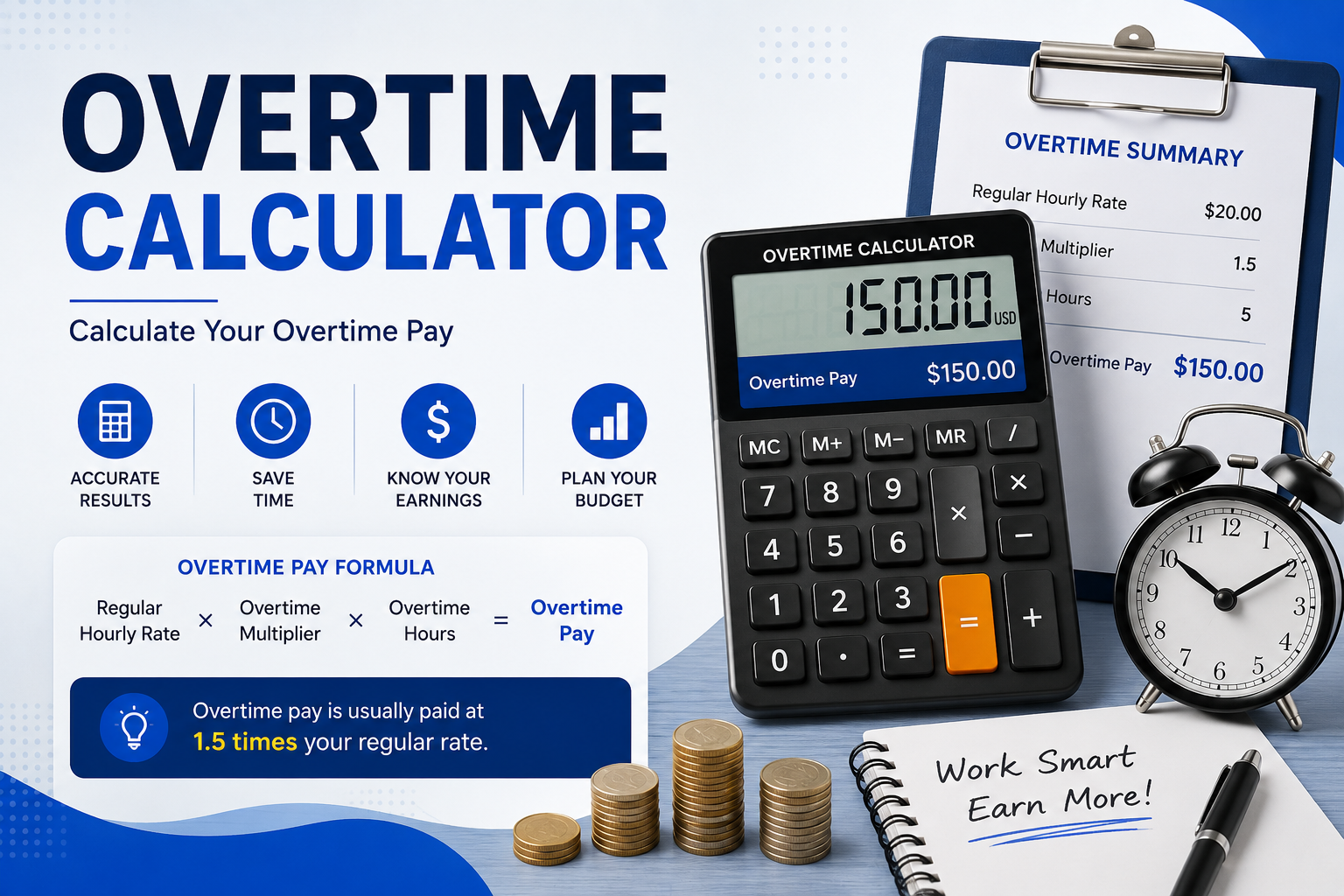
For example, imagine that you normally earn $20 per hour and your applicable overtime rate is 1.5 times your regular hourly rate. Your overtime rate would be:
$20 × 1.5 = $30 per hour
If you worked five overtime hours at that rate, your estimated overtime earnings would be:
$30 × 5 = $150
Instead of performing these calculations yourself every time your schedule changes, an Overtime Calculator can calculate the figures in seconds.
Keep in mind that actual overtime eligibility and rates depend on applicable laws, employment classifications, contracts, and workplace policies.
How Does an Overtime Calculator Work?
Using an Overtime Calculator is usually straightforward.
The calculator may ask you to enter your regular hourly wage, regular working hours, overtime hours, and overtime multiplier.
Once these details are entered, the calculator applies the appropriate mathematical formula to estimate your overtime earnings.
A basic formula is:
Overtime Pay = Regular Hourly Rate × Overtime Multiplier × Overtime Hours
Suppose your normal hourly wage is $25, your overtime multiplier is 1.5, and you worked eight overtime hours.
First, calculate your overtime rate:
$25 × 1.5 = $37.50
Then calculate your overtime earnings:
$37.50 × 8 = $300
Your estimated overtime pay would therefore be $300 before applicable taxes and deductions.
An Overtime Calculator automates this process and reduces the chance of simple mathematical mistakes.
What Is Overtime Pay?
Overtime pay generally refers to additional compensation paid for qualifying hours worked beyond a defined threshold.
However, overtime rules are not identical everywhere.
The number of hours that trigger overtime, the employees who qualify, and the rate at which overtime must be paid can depend on the country, state, province, employment category, contract, and other factors.
In the United States, for example, federal law generally requires covered, nonexempt employees to receive overtime pay at least one and one-half times their regular rate for hours worked over 40 in a workweek. Certain exemptions and special rules apply.
Because regulations vary, an Overtime Calculator should be treated as an estimation tool rather than a determination of your legal entitlement.
What Does Time-and-a-Half Mean?
“Time-and-a-half” is a common phrase used when discussing overtime.
It means an employee receives 1.5 times their regular hourly rate for qualifying overtime hours.
If your normal wage is $16 per hour:
$16 × 1.5 = $24
Your time-and-a-half rate would therefore be $24 per hour.
If you worked six overtime hours at this rate:
$24 × 6 = $144
Your estimated overtime earnings would be $144.
An Overtime Calculator makes these calculations particularly convenient when your wage or overtime hours change from week to week.
How to Calculate Overtime Pay
Calculating basic overtime pay involves a few steps.
First, determine your regular hourly rate.
Next, identify the overtime multiplier that applies to the hours you are calculating. For a time-and-a-half example, this would be 1.5.
Multiply your regular rate by the overtime multiplier:
Regular Hourly Rate × Overtime Multiplier = Overtime Hourly Rate
Then multiply the overtime rate by the number of overtime hours:
Overtime Hourly Rate × Overtime Hours = Overtime Earnings
For example, if your regular wage is $22 per hour and you work seven overtime hours at 1.5 times your regular rate:
$22 × 1.5 = $33
Then:
$33 × 7 = $231
Your estimated overtime earnings would be $231.
An Overtime Calculator performs the same calculation automatically after you provide the necessary information.
Overtime Calculator Example
Consider an employee who earns $24 per hour and works 45 hours during a week.
For this simplified example, assume the first 40 hours are paid at the regular rate and the remaining five qualify for overtime at 1.5 times the regular rate.
Regular earnings:
40 × $24 = $960
Overtime rate:
$24 × 1.5 = $36
Overtime earnings:
5 × $36 = $180
Estimated total gross earnings:
$960 + $180 = $1,140
An Overtime Calculator can provide these estimates instantly, making it easier to understand how additional working hours could affect your gross paycheck.
Regular Pay vs. Overtime Pay
Regular pay and overtime pay are related, but they are not necessarily calculated in the same way.
Regular pay generally represents compensation for ordinary working hours at your normal rate.
Overtime pay applies to qualifying additional hours and may be calculated using a higher rate.
For example, an employee earning $20 per hour might receive $20 for regular hours and $30 for qualifying overtime hours when a 1.5 multiplier applies.
An Overtime Calculator helps separate these amounts so you can see how much of your estimated earnings comes from regular work and how much comes from overtime.
How Much Is Overtime at $15 Per Hour?
Suppose your regular hourly rate is $15 and your overtime multiplier is 1.5.
Your overtime rate would be:
$15 × 1.5 = $22.50 per hour
If you worked 10 qualifying overtime hours:
$22.50 × 10 = $225
You would earn an estimated $225 in overtime pay before applicable taxes and deductions.
Using an Overtime Calculator allows you to change the number of hours and immediately see how your estimated earnings change.
How Much Is Overtime at $20 Per Hour?
At a regular wage of $20 per hour and a 1.5 overtime multiplier:
$20 × 1.5 = $30 per hour
If you worked five qualifying overtime hours:
$30 × 5 = $150
If you worked 10 overtime hours:
$30 × 10 = $300
And 15 overtime hours would equal:
$30 × 15 = $450
An Overtime Calculator is particularly convenient when you want to compare several possible work schedules without repeating the calculations manually.
How Much Is Overtime at $25 Per Hour?
If your regular wage is $25 per hour, a time-and-a-half overtime rate would be:
$25 × 1.5 = $37.50 per hour
Eight qualifying overtime hours would therefore produce estimated overtime earnings of:
$37.50 × 8 = $300
This illustrates why even a small change in overtime hours can noticeably affect gross earnings.
What Is Double-Time Pay?
Some employment arrangements or applicable rules may provide double-time compensation in particular circumstances.
Double time means two times the regular hourly rate.
For example, if your regular wage is $20 per hour:
$20 × 2 = $40 per hour
Five hours at that rate would equal:
$40 × 5 = $200
If your Overtime Calculator allows you to change the overtime multiplier, you may be able to enter 2.0 instead of 1.5 to estimate double-time earnings.
Whether double time actually applies depends on the relevant employment rules, agreement, and jurisdiction.
Can Salaried Employees Receive Overtime?
Being paid a salary does not, by itself, provide enough information to determine overtime eligibility.
Eligibility depends on applicable employment law, job duties, compensation structure, exemptions, and other requirements.
This distinction is important because people sometimes assume that every salaried employee is automatically excluded from overtime.
If a salaried worker qualifies for overtime under applicable rules, determining the correct regular rate may involve additional calculations.
For situations like these, a basic Overtime Calculator can provide an estimate, but employees and employers should consult the applicable labor authority or qualified professional when determining legal obligations.
Gross Overtime Pay vs. Take-Home Overtime Pay
An important point to remember is that the result from an Overtime Calculator will often represent gross earnings.
Gross overtime pay is the amount before applicable taxes and deductions.
Take-home pay is the amount you actually receive after deductions.
Suppose your calculated overtime earnings are $300. This does not necessarily mean your paycheck will increase by exactly $300.
Applicable taxes, insurance premiums, retirement contributions, payroll deductions, and other items can affect the final amount.
Therefore, check whether your Overtime Calculator is showing gross overtime pay or estimated net pay.
Why Use an Overtime Calculator?
Manual calculations are possible, but an Overtime Calculator can make the process faster and more convenient.
It can help employees estimate how much they may earn from additional working hours and compare different schedules before deciding whether extra shifts fit their financial goals.
Employers and managers may also use overtime estimates when planning staffing expenses, although payroll calculations should always follow the applicable legal and payroll requirements.
For personal budgeting, seeing your regular earnings and potential overtime separately can make expected income easier to understand.
Overtime Calculator for Employees
Employees can use an Overtime Calculator to estimate upcoming gross earnings.
Suppose your employer offers an optional extra shift. Before accepting it, you may want to know approximately how much additional income the shift could produce.
Enter your hourly rate, qualifying overtime hours, and applicable multiplier into the calculator.
You can then compare your estimated regular and overtime earnings.
This may help with short-term financial planning, particularly if your working hours change regularly.
Overtime Calculator for Employers
An Overtime Calculator can also be useful for preliminary workforce planning.
If several employees are expected to work additional hours, estimating overtime expenses can help businesses understand potential labor costs.
For example, a manager could compare the estimated cost of overtime with other staffing options.
However, a simple online calculator should not replace payroll systems, legal guidance, or official records. Actual payroll must account for applicable employment laws, employee classifications, pay structures, deductions, and company policies.
Common Overtime Calculation Mistakes
One common mistake is applying the overtime multiplier to all working hours instead of only the hours that qualify for the overtime rate.
Another is assuming that overtime always begins after the same number of hours everywhere.
People may also assume that every worker automatically qualifies for overtime or that every workplace uses exactly the same overtime multiplier.
These assumptions can lead to inaccurate estimates.
An Overtime Calculator simplifies the mathematics, but the result is only as reliable as the information you enter.
Always verify your regular rate, qualifying overtime hours, multiplier, and relevant employment rules.
How Overtime Can Affect Your Paycheck
Overtime can significantly increase gross earnings, especially for employees who regularly work additional qualifying hours.
For example, assume an employee earns $18 per hour and works 10 overtime hours at a 1.5 rate.
The overtime rate would be:
$18 × 1.5 = $27
Overtime earnings would be:
$27 × 10 = $270
That extra amount could make a meaningful difference to gross weekly income.
However, take-home pay may increase by a different amount because payroll deductions and taxes still apply.
An Overtime Calculator gives you a quick estimate before those additional considerations.
Tips for Getting Accurate Overtime Estimates
For a useful estimate, always enter accurate information.
Check your current regular rate rather than relying on an older wage. Enter only the hours that actually qualify for the overtime rate you are calculating.
Also confirm the appropriate multiplier.
Do not automatically select 1.5 simply because time-and-a-half is common in some circumstances. Different rules or agreements may apply.
Finally, remember that an Overtime Calculator estimates earnings based on the values entered. It does not independently determine whether particular hours legally qualify as overtime.
Frequently Asked Questions About Overtime Calculator
What is an Overtime Calculator?
An Overtime Calculator is a tool that estimates overtime earnings based on information such as your regular hourly rate, qualifying overtime hours, and overtime multiplier.
How do I calculate overtime at time-and-a-half?
Multiply your regular hourly wage by 1.5. Then multiply the resulting overtime rate by the number of qualifying overtime hours.
What is $20 an hour at time-and-a-half?
$20 multiplied by 1.5 equals $30 per hour.
What is $25 an hour at time-and-a-half?
$25 multiplied by 1.5 equals $37.50 per hour.
What is $30 an hour at time-and-a-half?
$30 multiplied by 1.5 equals $45 per hour.
Does an Overtime Calculator include taxes?
A basic calculator usually estimates gross overtime earnings before taxes and deductions. Whether taxes are included depends on the specific features of the calculator.
Does everyone qualify for overtime?
No. Eligibility depends on the applicable laws, employee classification, job duties, employment arrangements, and other factors.
Is overtime always paid at 1.5 times the regular rate?
No. Overtime rules and rates can vary depending on jurisdiction and circumstances. Always check the rules applicable to your employment situation.
Final Thoughts
Working additional hours can increase your income, but understanding exactly what those hours may be worth is important.
An Overtime Calculator provides a simple way to estimate overtime earnings using your regular hourly rate, qualifying overtime hours, and applicable overtime multiplier. Instead of repeatedly working through formulas by hand, you can get an estimate within seconds.
Whether you are checking an upcoming paycheck, considering an extra shift, planning a monthly budget, or estimating payroll costs, an Overtime Calculator can make the numbers easier to understand.
For the most useful results, enter accurate information and remember that overtime laws and eligibility requirements vary. The calculator should be used as an estimation tool, while official labor authorities, employment agreements, payroll records, and qualified professionals should be consulted when determining actual legal or payroll obligations.
For official information about overtime pay, eligibility, and federal wage rules, visit the U.S. Department of Labor – Overtime Pay page. It provides helpful guidance on overtime requirements under federal law.
One Response