
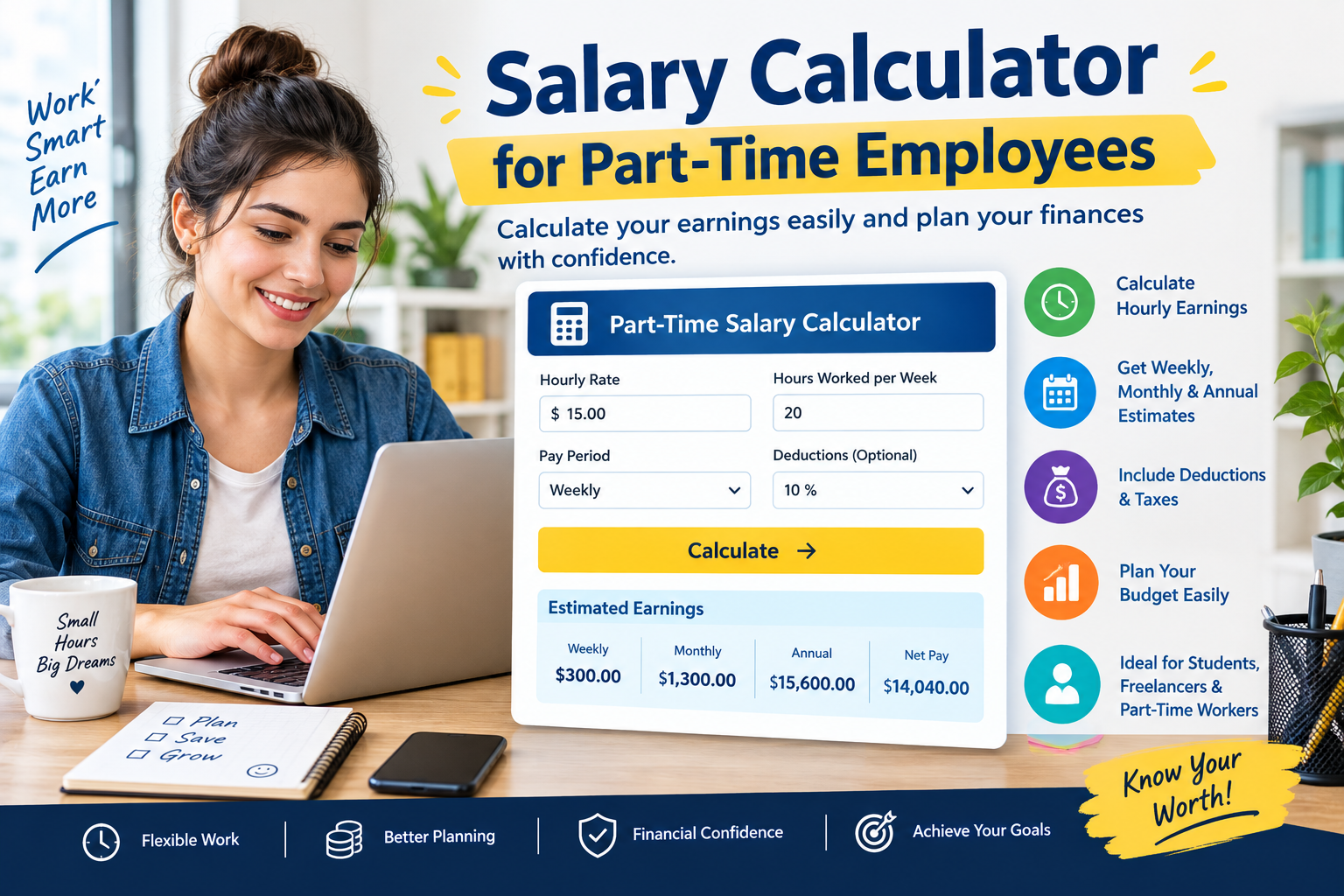
Part-time work has become an important part of the modern workforce. Students, parents, freelancers, retirees, and people looking for additional income often choose part-time jobs because they provide flexibility. However, calculating part-time earnings can sometimes be confusing because employees may be paid by the hour, week, month, or another pay period. A Salary Calculator for Part-Time Employees can make this process much easier by estimating earnings based on hours worked, hourly pay, pay frequency, and applicable deductions.
Understanding your expected income is useful when planning a monthly budget, comparing job opportunities, or determining whether a part-time position meets your financial goals. Instead of performing multiple calculations manually, an online calculator can provide a quick estimate using a few simple details.
Table of Contents
ToggleWhat Is a Salary Calculator for Part-Time Employees?
A Salary Calculator for Part-Time Employees is an online tool designed to estimate the earnings of people who work fewer hours than a typical full-time schedule. Salary Calculator for Part-Time Employees It can calculate expected income from an hourly wage and the number of hours worked.
For example, if a part-time employee earns $18 per hour and Salary Calculator for Part-Time Employees works 20 hours per week, the calculator can estimate weekly, monthly, and annual gross earnings.
The basic calculation is simple:
Hourly Rate × Hours Worked = Gross Pay
If someone works different hours each week, the calculation may need to account for the actual schedule. Some calculators also allow users to enter overtime, bonuses, taxes, or other deductions.
Why Part-Time Employees Need Salary Calculations
Part-time workers may have changing schedules. One week they might work 15 hours, while another week they could work 25 hours. This makes it difficult to estimate regular income without keeping detailed records.
A Salary Calculator for Part-Time Employees canSalary Calculator for Part-Time Employees help workers understand their expected earnings before receiving their paycheck.
It can be useful for:
- Estimating weekly income
- Calculating monthly earnings
- Estimating annual salary
- Comparing different part-time jobs
- Planning household budgets
- Understanding gross pay
- Estimating deductions
- Comparing hourly rates
- Tracking changes in working hours
Having a clear estimate can make financial planning more organized.
How Part-Time Salary Is Calculated
The simplest way to calculate part-time earnings is to multiply the hourly rate by the number of hours worked.
For example, suppose an employee earns $20 per hour and works 18 hours per week.
The weekly gross pay would be:
$20 × 18 = $360
If the employee works the same schedule throughout the year, the annual gross income can be estimated by multiplying weekly earnings by the number of working weeks.
A Salary Calculator for Part-Time Employees can perform these calculations automatically and convert the result into different pay periods.
Hourly Pay and Part-Time Work
Many part-time employees are paid an hourly wage. Their total earnings depend on both their hourly rate and the number of hours worked.
Consider two employees:
- Employee A earns $15 per hour and works 25 hours per week.
- Employee B earns $18 per hour and works 18 hours per week.
Although Employee B has a higher hourly rate, Employee A works more hours. Their total earnings therefore need to be calculated rather than judged only by the hourly wage.
Using a Salary Calculator for Part-Time Employees makes it easier to compare hourly rates and working schedules.
Weekly Part-Time Salary
Weekly income is one of the easiest figures to calculate. Multiply the hourly wage by the total number of hours worked during the week.
For example:
$16 × 22 hours = $352 weekly gross pay
This figure represents gross earnings before taxes and other deductions.
If your schedule changes every week, you can calculate each week’s expected earnings separately. This can be especially helpful for workers whose schedules depend on business demand.
Monthly Part-Time Salary
Monthly income can be more difficult because the number of working days and weeks varies from month to month.
One common approach is to calculate annual income first and then divide it by 12.
For example, if estimated annual gross earnings are $24,000:
$24,000 ÷ 12 = $2,000 average monthly gross income
A Salary Calculator for Part-Time Employees can provide an estimated monthly figure without requiring manual calculations.
The actual amount received in a particular month may still differ if the employee’s working hours change.
Annual Income for Part-Time Workers
Annual income is useful when comparing part-time employment opportunities. To estimate annual gross earnings, multiply the hourly rate by expected weekly hours and the number of working weeks.
For example:
$17 × 20 hours × 50 weeks = $17,000
This assumes a consistent schedule and 50 paid working weeks.
Real-world earnings can be different because of holidays, unpaid leave, schedule changes, overtime, or changes in hourly pay.
Using a Salary Calculator for Part-Time Employees can help workers create an estimated annual income based on their expected schedule.
Gross Pay vs. Net Pay
It is important to understand the difference between gross and net pay.
Gross pay is the amount earned before deductions.
Net pay is the amount remaining after applicable deductions.
Deductions may include taxes, insurance contributions, retirement contributions, or other payroll deductions depending on the employee’s location and employment arrangement.
A Salary Calculator for Part-Time Employees may offer both gross and estimated net pay calculations if tax and deduction information is supported.
Because tax rules differ by country and individual circumstances, calculated net pay should be treated as an estimate.
Part-Time Employees and Taxes
Part-time employment does not automatically mean that no taxes apply. Tax treatment depends on factors such as income level, location, employment status, and applicable tax rules.
Employees should use current official tax information when determining their actual tax obligations.
An online salary calculator can help estimate income, but it should not be treated as an official tax filing tool.
When using a Salary Calculator for Part-Time Employees, users should check whether the calculator supports their country and whether its tax assumptions are current.
Comparing Part-Time Job Offers
A calculator can be especially helpful when comparing two or more job offers.
Suppose one employer offers $16 per hour for 25 hours per week, while another offers $19 per hour for 18 hours per week.
The higher hourly wage does not automatically mean higher total weekly income. You need to consider both the hourly rate and expected working hours.
Other factors should also be considered, such as benefits, commuting costs, schedule flexibility, and unpaid time.
A Salary Calculator for Part-Time Employees can provide the income portion of this comparison.
Flexible Work Schedules
Part-time workers often have flexible schedules. Some employees work mornings, evenings, weekends, or different shifts each week.
If working hours vary, estimating annual income becomes more challenging.
For example, an employee may work:
- 15 hours in Week 1
- 20 hours in Week 2
- 25 hours in Week 3
- 18 hours in Week 4
Calculating each week separately can provide a more realistic estimate of average earnings.
A Salary Calculator for Part-Time Employees can help users adjust their hours and see how changes affect expected income.
Overtime and Additional Hours
Some part-time employees may occasionally work additional hours. Whether those hours qualify for overtime depends on applicable employment laws and workplace policies.
If additional hours are paid at a different rate, they should be calculated separately.
For example, regular hours may be paid at one hourly rate while qualifying overtime hours may receive a higher rate.
Before entering overtime into a calculator, confirm how your employer defines and pays overtime.
Benefits and Other Compensation
Salary is not always the complete picture when evaluating employment.
Some part-time jobs may offer benefits, paid leave, bonuses, discounts, retirement contributions, or other forms of compensation. Other positions may offer only hourly wages.
A salary calculator primarily focuses on monetary earnings. Therefore, users should consider the full compensation package when comparing employment options.
The Salary Calculator for Part-Time Employees can provide a useful income estimate, but it does not necessarily represent the total value of an employment package.
Using a Salary Calculator Accurately
To get a useful estimate, enter accurate information into the calculator.
You may need:
- Hourly wage
- Average weekly hours
- Number of working weeks
- Pay frequency
- Overtime hours, if applicable
- Estimated deductions
- Tax information, where supported
Avoid entering your maximum possible hours if you normally work fewer hours. Using realistic averages will produce a more meaningful estimate.
A Salary Calculator for Part-Time Employees works best when the information entered reflects your actual or expected work schedule.
Benefits of an Online Salary Calculator
Online calculators can save time and reduce the need for manual arithmetic.
Important benefits include:
- Fast results
- Easy calculations
- Multiple pay-period estimates
- Simple hourly wage calculations
- Useful budgeting information
- Convenient comparison of job offers
- Easy access from mobile devices
- Helpful estimates for annual income
For people with changing schedules, a calculator can also make it easier to update income estimates whenever working hours change.
Budgeting With Part-Time Income
Budgeting can be challenging when income varies. A part-time employee should ideally build a budget using a realistic estimate rather than assuming the highest possible income.
For example, if weekly earnings normally range between $300 and $450, using an average or conservative estimate may provide a more practical starting point for planning regular expenses.
The Salary Calculator for Part-Time Employees can help determine an estimated monthly or annual income that can then be used for budgeting.
Workers should also consider irregular expenses and possible changes in their schedules.
Common Mistakes to Avoid
Several mistakes can lead to inaccurate salary estimates.
One common mistake is calculating monthly income by simply multiplying weekly income by four. A month does not always contain exactly four weeks.
Another mistake is forgetting unpaid time off or assuming that every week will have the same number of working hours.
Other errors include:
- Using the wrong hourly rate
- Entering incorrect working hours
- Forgetting overtime
- Ignoring deductions
- Confusing gross and net pay
- Using outdated tax information
Reviewing your inputs carefully can improve the accuracy of your estimate.
Who Can Benefit From a Part-Time Salary Calculator?
A Salary Calculator for Part-Time Employees can be useful for many types of workers.
Students can use it to estimate income from jobs around their class schedules. Parents can calculate earnings from flexible work arrangements. Retirees may use it to estimate additional employment income. Freelance or temporary workers can also use similar calculations when their income is based on hours.
Employers and managers may also use salary calculations when creating staffing budgets or comparing hourly labor costs.
Final Thoughts
Part-time employment offers flexibility, but variable working hours can make income calculations difficult. Understanding how hourly wages, working hours, pay periods, taxes, and deductions affect earnings can help workers make better financial plans.
A Salary Calculator for Part-Time Employees provides a convenient way to estimate gross and, where supported, net income. By entering an hourly rate and realistic working hours, users can quickly estimate weekly, monthly, and annual earnings.
Remember that calculator results are estimates. Actual pay can vary because of schedule changes, taxes, overtime rules, unpaid leave, bonuses, benefits, and employer-specific policies.
Whether you are considering a new part-time job, planning your monthly budget, or simply tracking your earnings, a reliable calculator can make salary calculations easier and more understandable. Use current information, check your inputs carefully, and compare the final estimate with your actual paycheck to maintain an accurate picture of your income.
One Response