Understanding how much you earn per hour can make it easier to manage your money, compare job offers, and plan your monthly budget.
A salary calculator by hour helps convert an annual or monthly salary into an estimated hourly wage.
This can be especially useful for employees who receive a fixed salary but want to know the value of their time.
What Is a Salary Calculator by Hour?
A salary calculator by hour is a simple online tool that estimates your hourly earnings based on your salary and working hours.
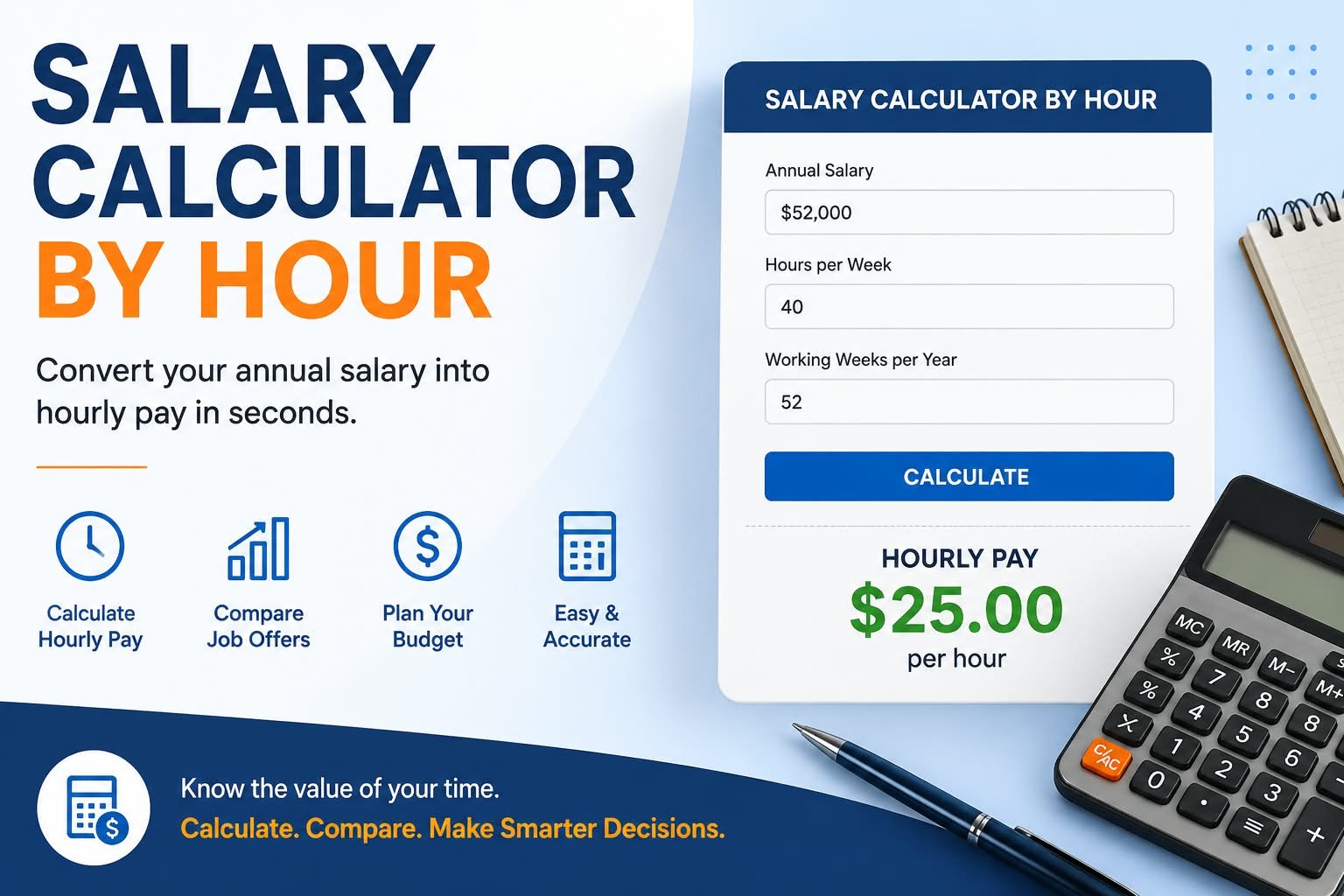
You normally enter your annual salary, the number of hours you work each week, and the number of working weeks in a year.
For example, if someone earns $52,000 per year and works 40 hours per week for 52 weeks, the estimated hourly pay is calculated by dividing the annual salary by the total number of working hours.
Hourly Pay = Annual Salary ÷ (Weekly Hours × Working Weeks)
Using this formula:
$52,000 ÷ (40 × 52) = $25 per hour.
This calculation gives an estimated gross hourly wage before taxes and other deductions.
Why Use a Salary Calculator by Hour?
A salary calculator by hour can be helpful when comparing different jobs.
One employer may offer an annual salary, while another may advertise an hourly wage.
Converting both offers to an hourly amount makes the comparison easier.
It can also help workers understand how their working hours affect their effective pay.
If you regularly work overtime, commute long distances, or work additional unpaid hours, looking at your earnings on an hourly basis can provide useful information.
How to Calculate Hourly Salary Manually
You do not always need an online calculator.
You can calculate your approximate hourly wage with a simple formula.
First, identify your annual salary. Next, determine how many hours you normally work each week.
Finally, multiply your weekly hours by the number of weeks you work each year.
For a standard schedule of 40 hours per week and 52 weeks per year:
40 × 52 = 2,080 working hours
If your annual salary is $60,000:
$60,000 ÷ 2,080 = approximately $28.85 per hour
A salary calculator by hour performs this calculation quickly and can be useful when you want to test different salary and working-hour combinations.
Annual Salary vs. Hourly Pay
Annual salary and hourly pay are two common ways employers compensate workers.
Salaried employees usually receive a fixed amount each year, while hourly employees are generally paid according to the number of hours they work.
For example, an annual salary of $50,000 may sound different from an hourly wage of $24.04.
However, when you calculate the yearly earnings based on 40 hours per week and 52 weeks, they are approximately equivalent.
The actual value can change depending on vacation, holidays, overtime, unpaid leave, and the number of hours worked.
Factors That Can Affect Your Hourly Rate
Your estimated hourly salary may change depending on several factors.
These include your normal weekly working hours, unpaid breaks, vacation time, holidays, overtime, and unpaid work performed outside your regular schedule.
Taxes and other deductions can also affect your take-home pay.
Therefore, the hourly amount calculated from an annual salary is usually a gross hourly rate, not the amount you receive after deductions.
For a more accurate estimate, you should consider your actual working schedule and the number of paid weeks in a year.
How a Salary Calculator by Hour Helps With Job Offers
When looking for a new job, salary comparisons can sometimes be confusing.
A position offering $55,000 per year may initially appear better than one offering $25 per hour.
However, the number of hours, benefits, overtime opportunities, and paid time off can make a significant difference.
Using a salary calculator by hour allows you to convert the offers into comparable hourly figures.
You can then consider other benefits such as health insurance, bonuses, retirement contributions, vacation days, and flexible working arrangements.
Final Thoughts
A salary calculator by hour is a convenient way to understand the relationship between annual salary and hourly earnings.
Whether you are comparing job offers, planning a budget, negotiating pay, or simply curious about your effective hourly wage, this calculation can provide a useful estimate.
Remember that the result is generally based on gross income and does not automatically account for taxes, benefits, overtime, or unpaid working hours.
For the most useful comparison, combine the hourly calculation with your actual work schedule and total employment benefits.
Salary Calculator by Hour: Calculate Your Hourly Earnings Easily
A salary calculator by hour is a useful tool for anyone who wants to understand how an annual or monthly salary translates into an hourly wage.
Many employees receive a fixed yearly salary, but thinking about income on an hourly basis can make it easier to compare jobs, plan a budget, evaluate overtime, and understand the value of working hours.
An hourly salary calculation is especially helpful when one job offers an annual salary while another offers an hourly wage.
By converting both amounts into the same format, workers can make a more informed comparison. A salary calculator by hour usually requires basic information such as annual salary, weekly working hours, and the number of working weeks per year. Once these details are entered, the calculator estimates the gross hourly rate.
How Does a Salary Calculator by Hour Work?
The basic calculation is simple. To estimate an hourly wage from an annual salary, divide the annual salary by the total number of working hours in a year. The total working hours can be calculated by multiplying weekly working hours by the number of working weeks.
Hourly Rate = Annual Salary ÷ (Weekly Hours × Working Weeks)
For example, suppose an employee earns $52,000 per year and works 40 hours per week for 52 weeks. The total annual working hours are 2,080. Dividing $52,000 by 2,080 gives an estimated hourly rate of $25. This means the employee earns approximately $25 per working hour before taxes and other deductions.
A salary calculator by hour performs this calculation automatically, saving time and reducing the chance of making a mathematical mistake. Users can also change their working hours or annual salary to see how the estimated hourly rate changes.
Why Calculate Your Hourly Salary?
Knowing your hourly salary can provide a clearer picture of your earnings. Annual salaries can sometimes make it difficult to understand how much you are actually earning for each hour of work. Converting your salary into an hourly amount gives you another way to evaluate your compensation.
A salary calculator by hour can also be useful when comparing different employment opportunities. For example, one employer may offer $60,000 per year while another offers $28 per hour. At first, these numbers are difficult to compare directly. Converting both into hourly or annual earnings makes the comparison much easier.
The calculation can also help when negotiating a new salary. If you know your approximate hourly value, you can better understand how a proposed raise or salary adjustment affects your overall compensation.
Converting Monthly Salary to Hourly Pay
A monthly salary can also be converted into an estimated hourly wage. First, multiply the monthly salary by 12 to estimate the annual salary. Then divide the annual amount by the expected number of working hours per year.
For example, if someone earns $4,000 per month, their estimated annual salary is $48,000. If they work 40 hours per week for 52 weeks, they work approximately 2,080 hours annually. Dividing $48,000 by 2,080 gives an hourly rate of about $23.08.
A salary calculator by hour makes this process easier because users do not have to perform several calculations manually.
Salary, Hourly Wage, and Take-Home Pay
It is important to understand that an hourly salary calculation usually represents gross pay. Gross pay is the amount earned before taxes, insurance premiums, retirement contributions, and other deductions.
Your take-home pay may therefore be lower than the hourly rate shown by a calculator. Tax rules and deductions vary depending on location, employment status, and personal circumstances. For this reason, an estimated hourly rate should not be confused with your actual after-tax hourly income.
If you want to understand your real earnings, you can compare your gross hourly wage with your net income after deductions.
How Working Hours Affect Your Hourly Rate
The number of hours you work can have a major effect on your effective hourly earnings. Suppose two employees earn the same annual salary, but one works 40 hours per week while the other regularly works 50 hours. Their official annual salaries are identical, but their effective hourly earnings are different.
This is why a salary calculator by hour can be valuable when evaluating a job. It helps you consider not only the salary but also the amount of time required to earn that salary.
You can include regular working hours in the calculation and, when appropriate, consider additional unpaid working time to understand your effective hourly value.
Using a Salary Calculator for Job Comparison
Job seekers can use an hourly salary calculation when comparing employment offers. Salary is important, but it is not the only factor to consider. Benefits, bonuses, paid vacation, flexible schedules, commuting costs, and overtime policies can also affect the overall value of a job.
For example, a job with a slightly lower annual salary may offer more paid vacation or fewer working hours. Another job may offer a higher salary but require significantly more hours. A salary calculator by hour gives you a useful starting point for comparing these situations.
Final Thoughts
A salary calculator by hour is a simple and practical way to understand your earnings from a different perspective.
Whether you are an employee, freelancer, job seeker, or business owner, converting annual or monthly income into an hourly figure can make financial comparisons easier.
The basic calculation requires your salary, working hours, and working weeks, making it easy to estimate your gross hourly rate.
However, remember that the result is an estimate. Taxes, benefits, overtime, holidays, unpaid leave, and additional working hours can change your actual earnings.
For the best financial comparison, consider all parts of your compensation rather than looking at salary alone. Using a salary calculator by hour alongside other financial tools can help you make clearer decisions about work and income.
What Is a Salary Calculator by Hour