
Understanding your salary package is an important part of making career and financial decisions. When a company offers you a job, the salary mentioned in the offer letter may not be the same as the amount you receive in your bank account every month. Cost to Company Salary Calculator Employers often include several components in a salary package, such as basic salary, allowances, bonuses, insurance, retirement contributions, and other benefits.
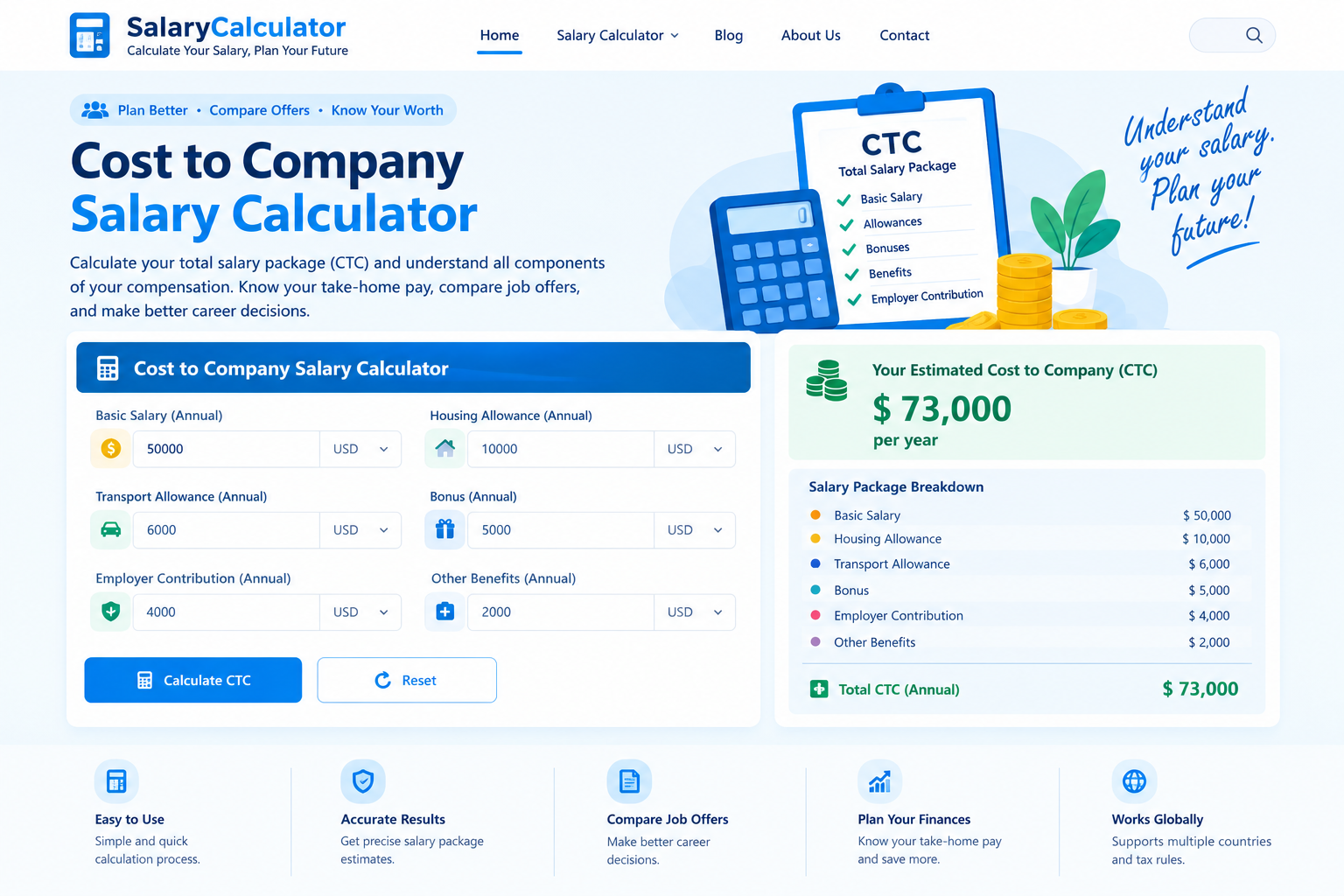
A Cost to Company Salary Calculator helps employees and job seekers understand the total annual cost an employer spends on an employee. It can also help you compare job offers, understand salary components, and estimate the difference between your total compensation and take-home pay.
Whether you are applying for your first job, Cost to Company Salary Calculator negotiating a salary increase, or considering a new employment opportunity, learning how CTC works can help you make more informed decisions.
In this guide, we will explain the meaning of CTC, the components of a salary package, how to calculate annual compensation, and how deductions can affect your final salary.
Table of Contents
ToggleWhat Is Cost to Company (CTC)?
Cost to Company, commonly known as CTC, is the total annual cost an employer incurs for employing a worker. It may include direct salary payments, allowances, employer contributions, insurance premiums, bonuses, and other employment benefits.
A Cost to Company Salary Calculator can help you understand these components by organising the amounts into a single annual compensation figure.
For example, imagine a company offers an employee an annual CTC of $60,000. This amount does not necessarily mean that the employee will receive $5,000 every month in their bank account. Some components may be paid annually, some may be non-cash benefits, and others may represent employer contributions.
The employee’s actual take-home pay depends on Cost to Company Salary Calculator the salary structure, tax rules, employee deductions, and payment arrangements applicable in that country.
It is important to remember that CTC is not calculated identically in every country. Some employers use the term extensively in their salary offers, while others use terms such as total compensation, annual remuneration, or total employment cost.
Why Use a Cost to Company Salary Calculator?
Calculating a salary package manually can be confusing, especially when an offer includes several allowances and benefits.
A Cost to Company Salary Calculator can make the process easier by helping you organise different salary components and estimate their combined value.
Here are some important benefits.
1. Understand Your Complete Salary Package
A job offer may include basic salary, housing allowance, transport allowance, performance bonuses, and insurance benefits. Looking only at the basic salary can give you an incomplete picture of the offer.
A calculator helps you combine eligible components to understand the total compensation package.
2. Compare Different Job Offers
Suppose one company offers an annual salary of $48,000 with limited benefits, while another offers $52,000 including substantial insurance and retirement benefits.
Comparing the headline figures alone may not be sufficient. Cost to Company Salary Calculator You should consider the cash salary, benefits, deductions, and conditions attached to each offer.
A Cost to Company Salary Calculator can help you organise these amounts before deciding which opportunity suits your needs.
3. Estimate Monthly Compensation
Many employers advertise annual salary packages, while employees usually plan their budgets monthly.
Dividing annual CTC by 12 gives the average monthly CTC equivalent. However, it does not necessarily equal monthly cash earnings because bonuses and certain benefits may be paid at different times.
4. Prepare for Salary Negotiations
Knowing your total compensation can help you negotiate more confidently. You can identify whether an offer provides sufficient fixed salary, whether a bonus is guaranteed, and how much of the package consists of benefits.
5. Improve Financial Planning
Understanding your expected income and deductions can help you plan rent, transport, groceries, savings, debt payments, and other expenses.
However, a CTC figure alone is not enough for budgeting. You should use your expected net salary or take-home pay for day-to-day financial planning.
Main Components of Cost to Company
The structure of a salary package depends on the employer, industry, country, and employment agreement. The following are common components that may form part of total compensation.
Basic Salary
Basic salary is the fixed core amount paid to an employee before applicable deductions. Some employment benefits and contributions may be calculated using basic salary as their reference amount.
For example, an employee may receive a basic annual salary of $36,000.
Allowances
Employers may provide additional payments for Cost to Company Salary Calculator housing, transportation, meals, communication, or other work-related expenses.
For example:
- Housing allowance: $6,000 annually
- Transport allowance: $2,400 annually
- Meal allowance: $1,200 annually
These amounts are illustrative. Whether an allowance is taxable or included in CTC depends on local rules and the employer’s salary structure.
Bonuses and Incentives
Performance bonuses, sales commissions, and other incentives may form part of an employee’s compensation.
A guaranteed bonus and a performance-based bonus should not be treated as equally certain. When comparing job offers, check whether the advertised amount is guaranteed, conditional, or merely a target.
Employer Retirement Contributions
Some employers contribute to pension plans, retirement funds, or other employee benefit arrangements.
These contributions may be included in the employer’s total employment cost but may not be available as immediate cash salary.
Insurance and Other Benefits
Medical insurance, life insurance, meal programmes, and other employer-provided benefits may also be included in a compensation package.
Their value depends on the coverage, eligibility conditions, and the method used by the employer to calculate CTC.
How to Calculate Cost to Company
The calculation generally involves adding the Cost to Company Salary Calculator annual values of the components included in the employer’s CTC definition.
Basic formula:
Annual CTC = Annual Fixed Salary + Allowances + Eligible Bonuses + Employer Contributions + Other Included Benefits
The exact formula depends on the employer’s policy. Avoid counting the same component twice.
Example of an Annual CTC Calculation
Suppose an employee receives the following illustrative compensation package:
| Salary Component | Annual Amount |
|---|---|
| Basic salary | $36,000 |
| Housing allowance | $6,000 |
| Transport allowance | $2,400 |
| Target bonus | $3,600 |
| Employer retirement contribution | $2,000 |
| Employer-paid insurance | $1,000 |
| Total illustrative CTC | $51,000 |
The calculation is:
$36,000 + $6,000 + $2,400 + $3,600 + $2,000 + $1,000 = $51,000.
Therefore, the total illustrative annual CTC is $51,000, assuming all listed components are included and there is no overlap.
Dividing the total by 12 gives an average monthly CTC equivalent of $4,250. This is not the same as monthly take-home salary because the package includes benefits, employer contributions, and a target bonus.
A Cost to Company Salary Calculator can help you perform this addition quickly when comparing different offers.
Difference Between CTC, Gross Salary, and Net Salary
These three terms describe different aspects of employee compensation.
Cost to Company
CTC represents the employer’s total annual cost under the applicable Cost to Company Salary Calculator compensation structure. It can include cash payments as well as non-cash benefits and employer contributions.
Gross Salary
Gross salary generally refers to earnings before employee-side deductions. Its exact definition can vary by country and payroll arrangement.
Gross salary may include basic salary and eligible allowances, and may include bonuses depending on the calculation period.
Net Salary
Net salary is the amount remaining after applicable employee deductions, such as income tax and employee contributions.
For example, suppose an employee has a monthly gross salary of $4,000 and total monthly deductions of $700.
Net salary = $4,000 − $700 = $3,300.
This is a simplified illustration. Actual deductions depend on local laws and the employee’s circumstances.
A Cost to Company Salary Calculator is most useful when you understand which amount represents total employer cost and which amount represents cash earnings.
How to Estimate Monthly Take-Home Salary
To estimate take-home pay, start with the employee’s gross cash earnings for the relevant period. Then subtract the employee-side deductions that apply.
Formula:
Estimated Net Salary = Gross Salary − Employee Deductions
Employee deductions may include income tax, employee pension contributions, social insurance, and other authorised payroll deductions.
Consider this example:
| Monthly Item | Amount |
|---|---|
| Gross cash salary | $4,000 |
| Estimated tax deduction | $450 |
| Employee retirement contribution | $150 |
| Other deductions | $100 |
| Estimated take-home pay | $3,300 |
The numbers above are illustrative and do not represent tax advice or the actual deductions in any particular country.
Employer contributions should not automatically be subtracted from gross salary because they may already be included in CTC without being deductions from the employee’s pay.
A Cost to Company Salary Calculator may provide Cost to Company Salary Calculator the starting point for understanding compensation, but you may need a separate salary-after-tax calculator to estimate your take-home pay accurately.
Cost to Company Salary Calculator for Different Countries
Salary structures and tax systems differ across the world. The terminology used in one country may not have exactly the same meaning in another.
India
In India, employers commonly use CTC when describing an annual compensation package. The package may include basic salary, allowances, employer provident fund contributions, gratuity provisions, insurance, and bonuses.
Employees should review the offer letter carefully to distinguish fixed monthly earnings from benefits and conditional payments.
Pakistan
In Pakistan, employers may describe compensation using monthly gross salary, basic salary, allowances, bonuses, and employer contributions. The term CTC may also be used by some employers, especially in corporate environments.
Employees should confirm the salary structure, applicable Cost to Company Salary Calculator income tax, and any employee-side contributions before estimating take-home pay.
United Arab Emirates
In the UAE, employment offers may specify a basic salary and allowances separately. These distinctions can be important when reviewing employment benefits and the terms of a contract.
Employees should check the applicable labour rules and the precise wording of their employment agreement.
United Kingdom
Employers in the UK commonly advertise annual gross salaries. Employer National Insurance costs and workplace pension contributions may form part of the employer’s total employment cost, but they are not automatically part of the employee’s gross salary.
Employees should use a suitable UK tax and take-home pay calculator for net salary estimates.
United States
In the United States, employers often discuss base salary, bonuses, health insurance, retirement benefits, and total compensation. Employer-paid benefits can increase the total employment cost beyond the employee’s cash salary.
Employees should distinguish annual compensation from taxable wages and net pay.
Common Mistakes When Calculating CTC
Even a simple calculation can become misleading if the salary components are not classified correctly.
Counting a bonus as guaranteed income: Performance bonuses may depend on individual results, company performance, or other conditions.
Ignoring employer contributions: Employer retirement contributions or insurance premiums may increase CTC without increasing monthly cash salary.
Confusing gross salary with CTC: Gross salary and total Cost to Company Salary Calculator employer cost are not necessarily the same.
Using the wrong tax rules: Tax rates and payroll contributions differ by country and may change over time.
Counting a component twice: Some employer packages include contributions within a stated benefit total. Adding them again can overstate CTC.
Ignoring payment timing: Annual bonuses, reimbursements, and benefits may not be paid monthly.
A Cost to Company Salary Calculator gives more useful results when you enter accurate figures and understand which components are included.
Tips for Comparing Salary Packages
Before accepting a job offer, consider the full value of the compensation rather than focusing only on the headline CTC.
- Check the fixed annual salary.
- Identify allowances and whether they are paid monthly.
- Confirm whether bonuses are guaranteed or performance-based.
- Review employer retirement contributions and insurance benefits.
- Estimate taxes and employee deductions using the rules that apply to you.
- Compare expected take-home pay and working conditions.
- Read the offer letter carefully before making your decision.
A slightly lower CTC may still be attractive if it provides a higher Cost to Company Salary Calculator fixed salary, stronger benefits, or better working conditions. Likewise, a larger package may contain significant variable compensation that is not guaranteed.
Frequently Asked Questions
1. What does CTC mean in salary?
CTC means Cost to Company. It generally represents the total Cost to Company Salary Calculator annual cost an employer incurs for an employee, including the compensation components and benefits defined by the employer.
2. Is CTC the same as take-home salary?
No. CTC can include employer contributions, insurance, and other benefits that are not paid directly as monthly cash salary. Take-home salary is the amount remaining after applicable employee deductions.
3. How do I calculate monthly CTC?
Divide the annual CTC by 12 to calculate its average monthly equivalent. This figure is not necessarily the employee’s actual monthly earnings.
4. Does CTC include bonuses?
It may include guaranteed or target bonuses, depending on the employer’s policy. Always check whether the bonus is guaranteed, conditional, or performance-based.
5. Can CTC be higher than gross salary?
Yes. CTC can be higher because it may include employer-paid insurance, retirement contributions, and other benefits beyond gross cash earnings.
6. Is a higher CTC always better?
Not necessarily. You should compare fixed salary, variable pay, benefits, deductions, job conditions, and expected take-home pay before choosing an offer.
7. Can a CTC calculator calculate income tax?
A basic CTC calculator may not calculate income tax. You may need a separate tax calculator that uses current rules for your country and individual circumstances.
Conclusion
Understanding your salary package is essential when applying for jobs, comparing employment offers, and planning your finances. Cost to Company includes more than just the amount paid into your bank account. It may also include allowances, bonuses, insurance, employer contributions, and other benefits.
A Cost to Company Salary Calculator can help you organise these components, estimate annual compensation, and understand how the total package differs from gross and net salary.
For accurate results, use the figures in your employment offer, avoid double-counting benefits, and check the tax and payroll rules applicable to your country. Most importantly, compare guaranteed cash earnings and expected take-home pay alongside the total compensation figure before making an employment decision.
One Response