
Choosing the right job is an important financial decision. Salary is one of the first things people consider when comparing job offers, changing careers, or evaluating their current position. However, comparing salaries is not always as simple as looking at two annual figures. Different jobs can have different pay periods, bonuses, deductions, benefits, working hours, taxes, and other compensation factors. A Salary Calculator for Salary Comparison can make this process easier by helping employees estimate and compare their potential earnings.
A good salary comparison should consider more than the basic salary. Employees may receive hourly wages, monthly salaries, annual bonuses, overtime payments, commissions, allowances, retirement contributions, health benefits, and other forms of compensation. Understanding the complete financial picture can help workers make better career decisions.
Table of Contents
ToggleWhat Is a Salary Comparison?
Salary comparison means evaluating the earnings offered by different jobs, employers, industries, or locations. A Salary Calculator for Salary Comparison can help organize salary information and make it easier to compare different employment opportunities.
For example, one employer may offer a higher annual salary but fewer benefits, while another may provide a slightly lower salary with better healthcare, retirement contributions, paid leave, and bonuses. Looking only at the base salary could make the second offer appear less attractive even when its total compensation is higher.
Salary comparison is therefore useful for both job seekers and existing employees who are considering a career move.
Why Salary Comparison Matters
A Salary Calculator for Salary Comparison can help you understand whether a job offer is financially competitive. Comparing salaries can also help employees prepare for negotiations and determine whether changing jobs could improve their financial situation.
Salary comparison may be useful when:
- Evaluating two job offers
- Negotiating a raise
- Comparing different careers
- Considering relocation
- Comparing full-time and part-time work
- Reviewing annual salary increases
- Evaluating bonuses and commissions
- Comparing different pay schedules
Having accurate salary information can make these decisions easier and more organized.
How a Salary Comparison Calculator Works
A Salary Calculator for Salary Comparison generally allows users to enter information about two or more income options. Depending on the calculator, you may enter annual salary, hourly rate, working hours, pay frequency, bonuses, deductions, and other information.
The calculator then converts the information into comparable figures. For example, an annual salary can be converted into monthly, weekly, or hourly earnings. This helps users compare jobs that use different compensation structures.
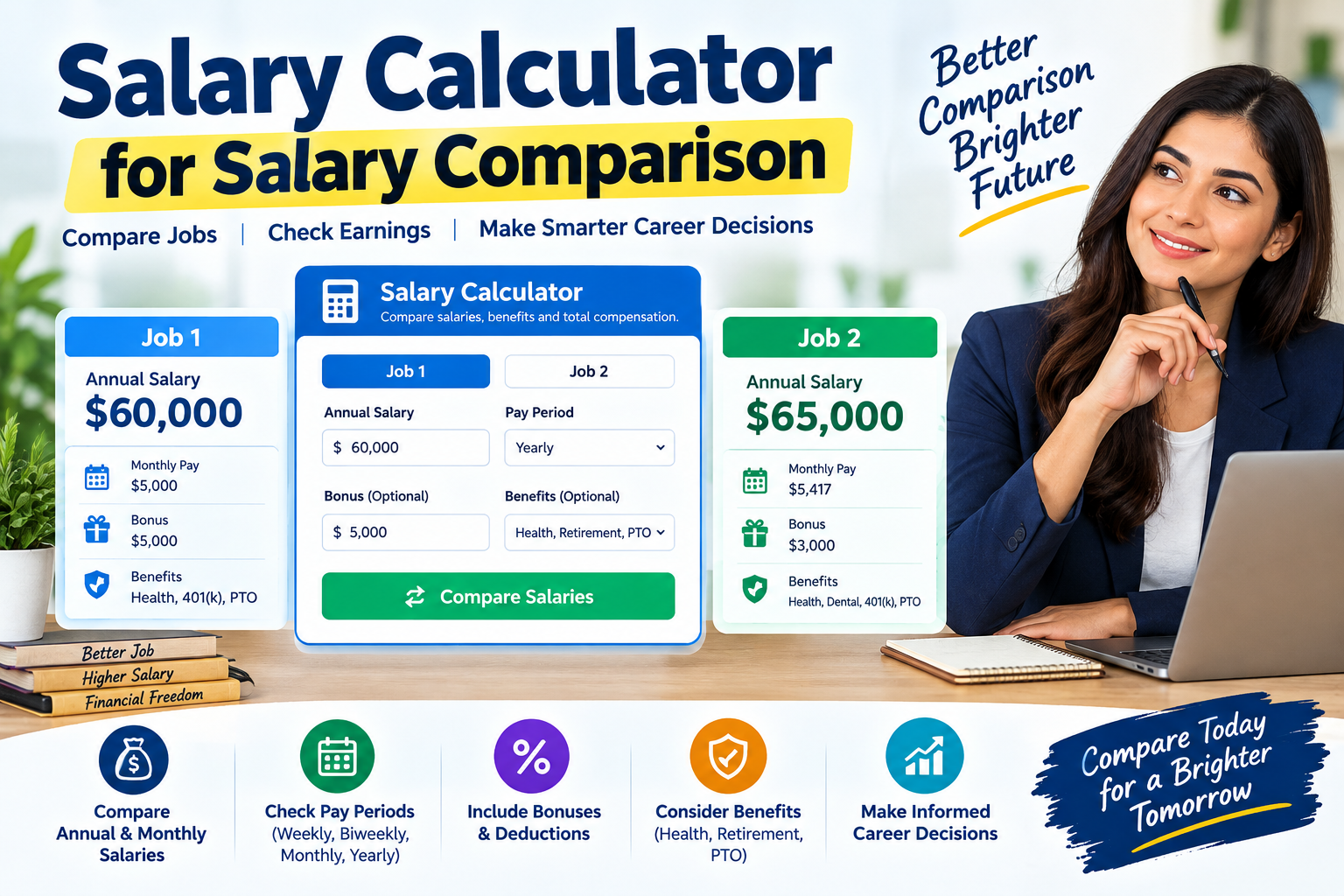
A simple comparison might look like this:
Job A: $60,000 per year
Job B: $65,000 per year
At first glance, Job B appears better because it offers a higher annual salary. However, additional factors may change the overall comparison.
Comparing Annual Salaries
Annual salary is one of the most common figures used when comparing jobs. A Salary Calculator for Salary Comparison can help convert different pay rates into annual estimates.
Suppose one employee earns $30 per hour and another earns a fixed annual salary of $62,000. If the hourly employee works 40 hours per week for approximately 52 weeks, the estimated annual earnings can be calculated before considering taxes and unpaid time off.
This allows users to compare different compensation formats more easily.
Comparing Monthly Income
Monthly income is important because many people manage their household budgets on a monthly basis. A Salary Calculator for Salary Comparison can convert annual salaries into estimated monthly amounts.
For example, an annual salary of $72,000 divided across twelve months gives an average gross monthly salary of $6,000. Comparing monthly figures can make it easier to understand how a new salary might fit into rent, transportation, food, savings, and other expenses.
However, actual monthly paychecks may vary depending on the employer’s payment schedule and deductions.
Comparing Hourly Pay
Hourly pay can be useful when comparing jobs with different working schedules. A Salary Calculator for Salary Comparison can help estimate annual earnings from an hourly wage.
For example, an employee earning $25 per hour and working 40 hours per week may have estimated gross annual earnings of $52,000 before taxes and other adjustments, assuming 52 paid weeks.
If another job offers $28 per hour but fewer working hours, the annual difference may be smaller than expected. This demonstrates why both hourly rate and working hours should be considered.
Gross Salary vs Net Salary
Gross salary is the amount earned before deductions, while net salary is the amount remaining after applicable deductions. A Salary Calculator for Salary Comparison can help users understand this distinction when evaluating income.
Two jobs with similar gross salaries can produce different take-home pay because of differences in taxes, benefits, retirement contributions, insurance costs, and other deductions.
When comparing job offers, it is useful to review both gross compensation and estimated net income whenever reliable information is available.
Comparing Benefits and Compensation
Salary is only one part of employment compensation. A Salary Calculator for Salary Comparison can be combined with information about benefits to create a broader comparison.
Common employee benefits include:
- Health insurance
- Retirement contributions
- Paid vacation
- Paid holidays
- Performance bonuses
- Stock options
- Commissions
- Transportation allowances
- Education assistance
- Flexible working arrangements
A job with a lower base salary may sometimes provide benefits that have significant financial value.
Comparing Bonuses
Bonuses can have a major effect on total compensation. A Salary Calculator for Salary Comparison can help include expected bonuses when comparing annual earnings.
For example, an employee earning $70,000 with a potential $5,000 annual bonus may have a different total compensation opportunity from someone earning $73,000 with no bonus.
However, bonuses should be evaluated carefully because some are guaranteed while others depend on individual or company performance.
Comparing Different Pay Periods
Employees may receive payments weekly, biweekly, semi-monthly, or monthly. A Salary Calculator for Salary Comparison can convert these different schedules into common figures.
For example, comparing a weekly paycheck with a monthly salary can be confusing without converting both figures to an annual or monthly basis.
Using a common time period makes the comparison clearer and reduces the possibility of misunderstanding the actual income difference.
Comparing Job Offers
One of the most useful applications of a Salary Calculator for Salary Comparison is evaluating job offers. Job seekers can enter the salary information from each offer and compare the potential earnings.
Before accepting an offer, consider:
- Base salary
- Expected bonus
- Overtime opportunities
- Benefits
- Retirement contributions
- Paid leave
- Insurance costs
- Commute expenses
- Working hours
- Career growth opportunities
A complete comparison can reveal differences that are not immediately visible from the advertised salary.
Comparing Salaries Between Careers
A Salary Calculator for Salary Comparison can also help people compare different career paths. Someone considering a career change may want to know how much income could be expected from a new profession compared with their current role.
Career comparisons should include education requirements, experience, working hours, location, growth potential, and benefits. Salary alone should not determine a long-term career decision, but it remains an important factor.
Comparing Salaries by Location
Location can have a major impact on salary and purchasing power. A Salary Calculator for Salary Comparison can help compare salary figures between different cities or regions.
For example, a job paying $80,000 in one city may not provide the same lifestyle as a $70,000 job in a location with lower housing and transportation costs.
Cost of living should therefore be considered alongside salary when comparing employment opportunities in different locations.
Salary Comparison and Cost of Living
Cost of living includes expenses such as housing, food, transportation, utilities, healthcare, and other everyday costs. A Salary Calculator for Salary Comparison provides income estimates, but users should combine these figures with local living costs.
A higher salary does not always mean more disposable income. If housing, transportation, and taxes are significantly higher in one location, the financial advantage may be smaller than the salary difference suggests.
Comparing Raises
Employees can also use a Salary Calculator for Salary Comparison to understand the impact of a raise. Even a small percentage increase can make a meaningful difference over an entire year.
For example, an employee earning $50,000 who receives a 5% raise would have a new gross salary of approximately $52,500. Calculating the difference can help employees understand the financial effect of salary negotiations.
Comparing Salary Growth
Salary growth is another important factor. A Salary Calculator for Salary Comparison can help employees compare current earnings with potential future earnings.
Career progression may include promotions, annual raises, increased responsibilities, bonuses, and changes in job title. Looking at long-term earning potential can sometimes be more useful than comparing only today’s salaries.
Salary Negotiation
Salary data can be valuable during negotiations. A Salary Calculator for Salary Comparison can help employees prepare by organizing their current salary and comparing it with alternative offers or market opportunities.
Before negotiating, research typical compensation for the role, consider your experience and skills, and understand the total value of the employment package.
A clear comparison can make a salary discussion more practical and focused.
Common Salary Comparison Mistakes
When using a Salary Calculator for Salary Comparison, users should avoid several common mistakes.
One mistake is comparing gross salary with net salary. These figures represent different stages of income and should not be treated as equivalent.
Another mistake is ignoring working hours. A job with a higher annual salary may require substantially more hours.
It is also important not to assume that every bonus is guaranteed. Some bonuses depend on performance or company results.
Accuracy of Salary Calculations
A Salary Calculator for Salary Comparison provides estimates based on the information entered. The accuracy of the result depends on the quality of the inputs.
For better results, enter accurate salary amounts, working hours, pay frequency, bonuses, and deductions. If the calculator estimates taxes, remember that tax rules can vary based on location and personal circumstances.
Online salary calculators should therefore be treated as planning tools rather than official payroll statements.
Benefits of Online Salary Comparison
Using a Salary Calculator for Salary Comparison can save time and make financial comparisons easier. Instead of manually converting hourly, weekly, monthly, and annual amounts, users can organize the information in one place.
The main advantages include:
- Faster calculations
- Easier job comparisons
- Better salary negotiation preparation
- Clearer understanding of pay periods
- Support for career planning
- Improved budgeting
- Easier comparison of compensation packages
These benefits make salary calculators useful for students, employees, job seekers, freelancers, and career professionals.
Salary Comparison for Employees
Employees can use a Salary Calculator for Salary Comparison to review whether their current compensation is competitive. If another company offers a higher salary, employees can compare the complete compensation package rather than focusing only on one number.
This information can also support discussions about promotions and raises. Employees who understand their current compensation are often better prepared to evaluate new opportunities.
Salary Comparison for Employers
Employers may also benefit from salary comparison tools. Businesses can use compensation data to understand whether their pay packages are competitive when recruiting and retaining employees.
Competitive compensation can help organizations attract qualified candidates and reduce employee turnover. Employers may also compare salaries across roles, experience levels, and departments when developing compensation structures.
Planning Your Career With Salary Data
Salary information can support long-term career planning. A Salary Calculator for Salary Comparison can help people evaluate whether additional education, certifications, experience, or career changes could improve their earning potential.
For example, someone may compare the current salary of an entry-level position with the potential salary of a more experienced role. This can provide useful context when setting professional goals.
Final Thoughts
A Salary Calculator for Salary Comparison is a practical tool for anyone who wants to compare employment income more effectively. By converting different salaries into common time periods and considering factors such as bonuses, benefits, deductions, working hours, and location, users can develop a clearer understanding of their financial options.
Whether you are comparing two job offers, negotiating a raise, planning a career change, or simply reviewing your current compensation, salary comparison can help you make more informed decisions.
Remember that salary is only one part of a complete employment package. Benefits, job security, career growth, working conditions, commute time, flexibility, and cost of living can all influence the real value of a job.
The best approach is to use salary calculations as a starting point, verify important figures, and consider the complete compensation package before making a major career decision.
One Response