
Understanding your salary before taxes is an important part of managing your income. When you receive a job offer or look at your payslip, the amount you earn before deductions can be different from the amount you actually take home. A Salary Calculator Before Tax helps you understand your gross earnings before taxes and other deductions are removed.
Whether you are paid hourly, weekly, biweekly, monthly, or annually, knowing your gross salary can make it easier to compare jobs, plan a budget, and understand your total compensation. This guide explains how gross salary works, how it can be calculated, and how an online calculator can make the process simpler.
Table of Contents
ToggleWhat Is a Salary Calculator Before Tax?
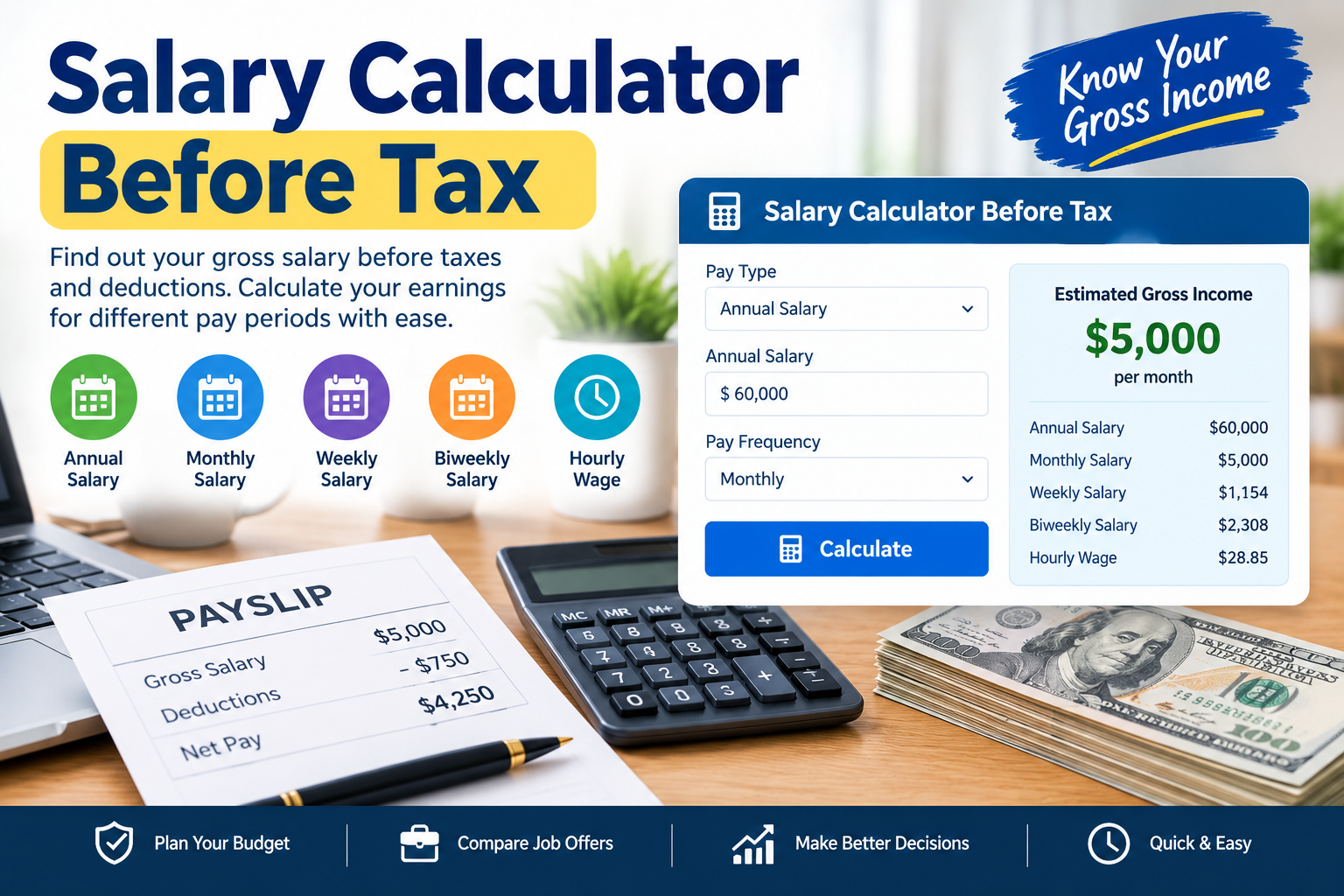
A Salary Calculator Before Tax is an online tool that estimates your gross income before taxes and other deductions are taken from your paycheck. Gross salary is the amount you earn based on your agreed pay rate before deductions.
For example, if an employee earns $60,000 per year, the annual gross salary is $60,000. Taxes, insurance, retirement contributions, and other deductions may reduce the amount eventually received in the employee’s bank account.
A calculator can convert an annual salary into monthly, weekly, daily, or hourly amounts, depending on the information entered.
What Does Before Tax Mean?
Before-tax income is commonly called gross income. It represents earnings before certain deductions are taken from your pay.
If your employer offers an annual salary, that amount is generally discussed as a gross salary. Your actual paycheck may be smaller because taxes and other deductions are withheld.
Using a Salary Calculator Before Tax allows you to focus on gross earnings without first calculating tax deductions. This is useful when you want to understand the basic value of a salary offer or convert an annual salary into different pay periods.
Why Calculate Your Salary Before Tax?
There are several reasons to calculate gross salary. One of the most common is comparing different employment opportunities.
Imagine one job offers an annual salary while another advertises an hourly rate. Comparing the numbers directly can be difficult. Converting both amounts into an annual or hourly equivalent creates a clearer comparison.
A Salary Calculator Before Tax can also help employees understand how much they earn during different periods. This can be useful for budgeting, negotiating compensation, and reviewing employment agreements.
Gross salary is also commonly used when discussing compensation with employers or recruiters.
Gross Salary vs. Net Salary
Gross salary and net salary are not the same thing.
Gross salary is the amount earned before deductions.
Net salary is the amount remaining after applicable taxes and other deductions have been taken out.
For example, an employee might have a gross monthly salary of $5,000, but the amount deposited into their bank account could be lower after taxes and other deductions.
A Salary Calculator Before Tax focuses on the gross amount. A separate after-tax calculation may be needed if you want to estimate take-home pay.
How a Salary Calculator Works
Most salary calculators use a few basic inputs. These may include annual salary, hourly wage, working hours, pay frequency, and sometimes the number of working weeks or days.
For a salaried employee, a basic annual-to-monthly calculation can be represented as:
Monthly Salary = Annual Salary ÷ 12
For weekly income:
Weekly Salary = Annual Salary ÷ 52
For hourly income, the calculation can depend on the number of working hours per week and weeks worked per year.
A Salary Calculator Before Tax performs these conversions automatically, helping users avoid repetitive manual calculations.
Annual Salary Calculation
Annual salary is one of the most common ways employers describe compensation. If an employee receives a fixed yearly salary, the annual amount represents gross earnings before deductions.
For example, an annual salary of $72,000 can be divided by 12 to estimate a gross monthly salary of $6,000.
This does not mean the employee will receive $6,000 in their bank account every month because taxes and other deductions may apply.
A Salary Calculator Before Tax can provide these gross pay-period estimates quickly.
Monthly Salary Calculation
Monthly salary is useful for people who manage regular household expenses, rent, subscriptions, and other recurring costs.
To estimate a monthly gross salary from an annual salary, divide the annual amount by 12.
For example:
$48,000 ÷ 12 = $4,000 per month
The result represents gross monthly income before taxes and deductions.
When using a Salary Calculator Before Tax, users can enter their annual salary and receive an estimated monthly amount without manually performing the calculation.
Weekly Salary Calculation
Weekly income is especially useful for employees who receive weekly pay or want to understand their annual compensation in weekly terms.
A simple annual-to-weekly calculation divides annual salary by 52.
For example:
$52,000 ÷ 52 = $1,000 per week
This is a gross weekly estimate. Actual payroll schedules and employer practices can vary.
A Salary Calculator Before Tax can make weekly salary conversions easier when comparing annual compensation with weekly earnings.
Biweekly Salary Calculation
Some employers pay employees every two weeks. This is known as biweekly pay.
There are generally 26 biweekly pay periods in a year. To estimate gross biweekly pay from an annual salary, divide the annual salary by 26.
For example:
$65,000 ÷ 26 = $2,500
This calculation gives an estimated gross amount per biweekly pay period.
A Salary Calculator Before Tax can help employees understand their compensation when an employer uses a biweekly payroll schedule.
Hourly Wage and Annual Salary
Hourly workers often need to convert their hourly wage into an estimated annual income.
A basic calculation is:
Annual Income = Hourly Rate × Hours Worked Per Week × Weeks Worked Per Year
For example, someone earning $25 per hour and working 40 hours per week for 52 weeks would have an estimated gross annual income of:
$25 × 40 × 52 = $52,000
This is a simplified calculation and assumes consistent working hours throughout the year.
A Salary Calculator Before Tax can help convert hourly pay into estimated weekly, monthly, and annual gross income.
Full-Time and Part-Time Employees
Salary calculations can differ depending on whether someone works full-time or part-time.
A full-time employee may have a fixed annual salary or a regular hourly schedule. A part-time employee may work fewer hours each week, making annual income dependent on the actual hours worked.
For hourly employees, changes in working hours can significantly affect gross income.
A Salary Calculator Before Tax can be used with different working-hour assumptions to estimate how changes in schedules may affect gross earnings.
Overtime and Additional Earnings
Some employees receive overtime pay in addition to their regular wages. Bonuses, commissions, tips, and other forms of compensation may also contribute to total earnings.
For example, an hourly employee may receive a standard hourly rate for regular hours and a different rate for eligible overtime hours.
When calculating total gross income, these additional earnings may need to be included separately.
A Salary Calculator Before Tax can provide a basic salary estimate, but users should check whether their particular calculator supports overtime, bonuses, or commissions.
Benefits and Total Compensation
Salary is only one part of an employee’s overall compensation package. Some employers also provide benefits such as health insurance, retirement contributions, paid leave, bonuses, or other benefits.
These benefits may have financial value but are not necessarily included in the base gross salary.
When comparing employment opportunities, it can be useful to look at both salary and the broader compensation package.
A Salary Calculator Before Tax is helpful for understanding the salary portion of an offer, while additional benefits should be reviewed separately.
Why Gross Salary Is Useful for Job Comparison
Job offers may use different compensation structures. One company may offer an annual salary, while another may advertise an hourly wage.
Converting both offers into the same pay period can make the numbers easier to understand.
For example, an employee can convert an hourly rate into estimated annual gross income and compare it with a salaried position.
A Salary Calculator Before Tax can simplify this process and provide consistent gross-income estimates.
Salary Raises and Promotions
A salary calculator can also help employees understand the effect of a raise.
Suppose an employee earns $50,000 annually and receives a 5% increase. The new gross salary would be:
$50,000 × 1.05 = $52,500
The increase can then be converted into monthly or weekly gross pay.
Using a Salary Calculator Before Tax makes it easier to see how a salary increase changes earnings before taxes.
Understanding Pay Frequency
Pay frequency determines how often employees receive their wages. Common schedules include weekly, biweekly, semimonthly, and monthly pay.
The number of paychecks does not necessarily change the employee’s annual salary. Instead, the annual gross amount is divided according to the employer’s payroll schedule.
For example, a $60,000 annual salary can be divided into 12 monthly payments or 26 biweekly payments.
A Salary Calculator Before Tax can help users understand these different payment schedules.
Factors That Can Affect Gross Pay
Several factors can affect gross earnings. These include hourly rates, working hours, overtime, bonuses, commissions, unpaid leave, and changes in employment status.
For salaried employees, the agreed annual salary generally forms the basis of gross compensation. However, additional payments can increase total earnings.
Hourly employees may see greater variation because their gross pay can change when the number of hours worked changes.
A Salary Calculator Before Tax provides an estimate based on the information entered, so accurate inputs are important.
How to Use a Salary Calculator Before Tax
Using a Salary Calculator Before Tax is usually simple.
Step 1: Choose Your Pay Type
Select whether you are entering an annual salary, hourly rate, weekly income, or another pay type.
Step 2: Enter Your Income
Enter the salary or hourly wage accurately.
Step 3: Add Working Hours
If you are paid hourly, enter your expected hours per week.
Step 4: Select the Pay Period
Choose annual, monthly, weekly, or biweekly income depending on what you want to calculate.
Step 5: Review the Result
The calculator will provide an estimated gross income for the selected period.
Example of a Before-Tax Salary Calculation
Consider an employee with an annual salary of $78,000.
The estimated monthly gross salary is:
$78,000 ÷ 12 = $6,500
The estimated weekly gross salary is:
$78,000 ÷ 52 = $1,500
The estimated biweekly gross salary is:
$78,000 ÷ 26 = $3,000
These figures represent gross earnings before taxes and other deductions.
A Salary Calculator Before Tax can provide these results instantly and may also support additional pay-period conversions.
Common Mistakes When Calculating Salary
One common mistake is confusing gross salary with take-home pay. Another is using the wrong number of pay periods.
Hourly workers may also forget to account for changes in weekly working hours or unpaid time away from work.
Users should also remember that bonuses and overtime may not be included in a basic salary calculation unless they are entered separately.
Checking each input before calculating can help produce a more useful estimate.
Benefits of Using an Online Calculator
Online salary calculators can save time and make salary conversions easier. They can be useful for employees, job seekers, employers, students, and anyone trying to understand income figures.
Instead of manually calculating multiple pay periods, users can enter their salary once and view different gross-income estimates.
A Salary Calculator Before Tax is particularly useful when reviewing job offers or planning income because it focuses on earnings before deductions.
Final Thoughts
Understanding gross salary is an important part of understanding your overall compensation. Whether you are paid hourly or receive an annual salary, converting your income into different pay periods can make financial information easier to understand.
A Salary Calculator Before Tax provides a convenient way to estimate annual, monthly, weekly, biweekly, and hourly earnings before taxes and other deductions. It can also help with job comparisons, salary raises, budgeting, and understanding different payroll schedules.
Remember that calculator results are estimates based on the information provided. Actual pay can vary because of overtime, bonuses, working hours, payroll schedules, taxes, benefits, and other deductions.
By understanding the difference between gross and net income and using accurate salary information, you can get a clearer picture of your earnings before tax.
2 Responses