
Getting a new job, negotiating a salary, or simply planning your monthly budget can feel confusing when you only know your annual salary. Your employer may tell you that you will earn a certain amount per year, but the amount that actually reaches your bank account can be quite different.
This is where a paycheck calculator can make things easier.
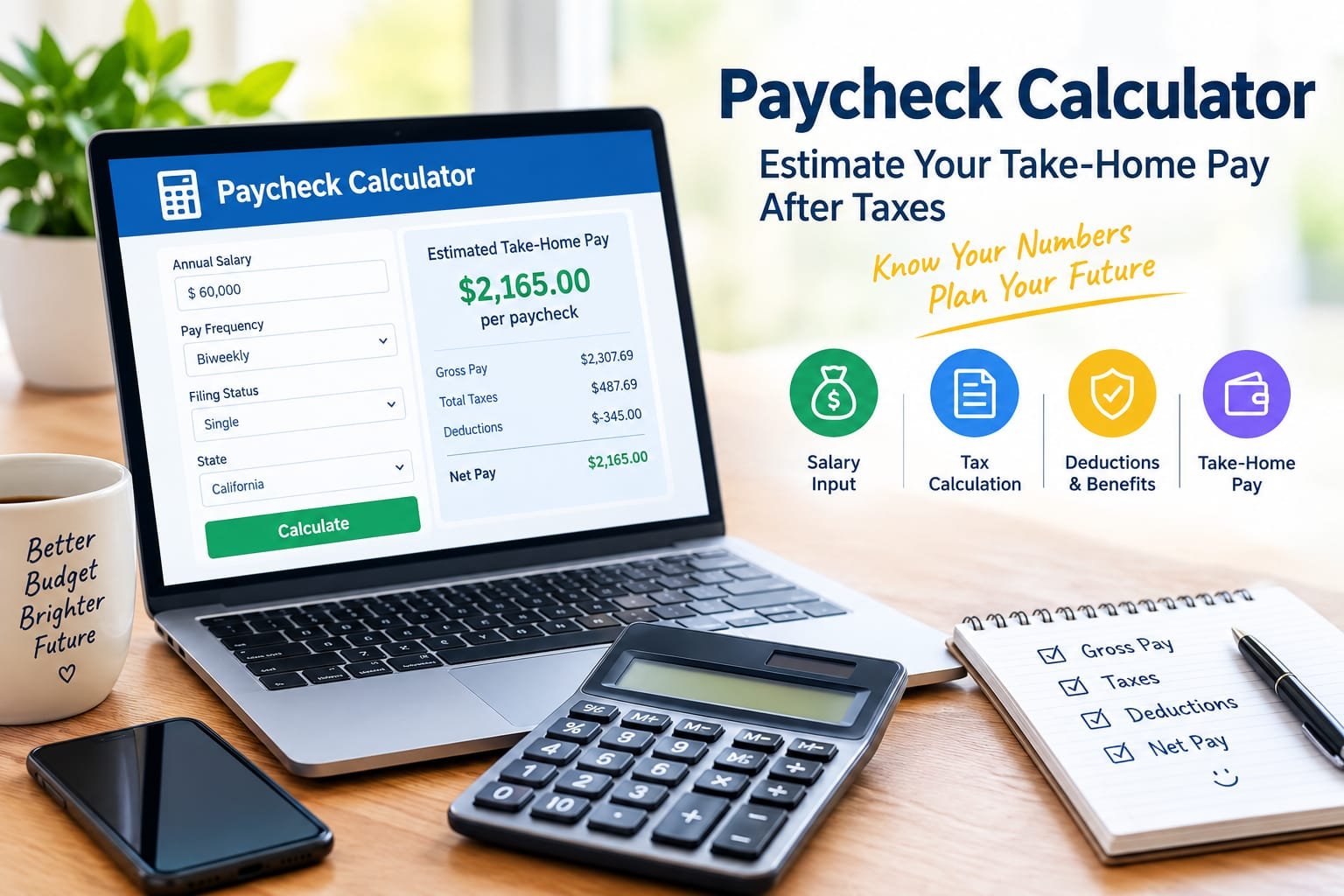
A paycheck calculator helps you estimate how much money you may receive in each paycheck after taxes and other deductions. Instead of guessing your take-home pay, you can enter your salary, pay frequency, location, and other basic information to get a clearer estimate.
Whether you are paid weekly, every two weeks, twice a month, or monthly, understanding your expected paycheck can help you make better financial decisions.
What Is a Paycheck Calculator?
A paycheck calculator is an online tool that estimates your take-home pay from your gross income.
Your gross salary is the amount you earn before taxes and deductions. Your net pay, also called take-home pay, is the amount you actually receive after applicable taxes and deductions have been removed.
For example, imagine someone earns $60,000 per year. It would be a mistake to simply divide $60,000 by 12 and assume that amount will arrive in their bank account every month.
Taxes and other deductions can reduce the amount considerably.
A paycheck calculator gives you a simple way to estimate this difference. Depending on the calculator, you may be able to enter information such as:
- Annual salary
- Hourly wage
- Hours worked
- Pay frequency
- Filing status
- State
- Dependents
- Pre-tax deductions
- Retirement contributions
- Other deductions
The more accurate information you provide, the more useful your estimate can be.
Why Use a Paycheck Calculator?
Knowing your gross salary is important, but knowing your expected take-home pay can be even more useful for everyday financial planning.
Suppose you receive a job offer with a salary of $70,000. At first, the number may look attractive. However, your actual paycheck will depend on taxes and deductions.
Using a paycheck calculator before accepting the offer can help you understand what that salary could mean in real life.
You can use your estimated take-home pay to plan for:
- Rent or mortgage
- Groceries
- Transportation
- Utilities
- Insurance
- Savings
- Retirement contributions
- Debt payments
- Entertainment
- Emergency expenses
This makes salary comparisons much more practical.
A $70,000 salary in one situation does not necessarily result in the same take-home pay as a $70,000 salary in another situation. Tax rules, deductions, filing status, and other factors can affect the final amount.
Gross Pay vs. Net Pay
One of the most important concepts to understand when using a paycheck calculator is the difference between gross pay and net pay.
Gross Pay
Gross pay is the amount you earn before taxes and other deductions are taken out.
For a salaried employee, gross annual pay might be $60,000. If you are paid twice a month, your gross pay per paycheck would generally start with an annual salary divided across the number of pay periods.
For hourly employees, gross pay can depend on the number of hours worked and the hourly rate.
Net Pay
Net pay is the amount you actually receive after applicable taxes and deductions.
This is the number that matters most when creating a personal budget because it represents the money available to you after payroll deductions.
A paycheck calculator helps bridge the gap between these two numbers.
How Does a Paycheck Calculator Work?
Most paycheck calculators follow a relatively simple process.
First, you enter your income information. This could be your annual salary or hourly wage.
Next, you provide information that can affect withholding, such as your filing status or state.
The calculator then estimates applicable taxes and deductions and subtracts them from your gross pay.
The general idea is:
Gross Pay − Taxes − Deductions = Estimated Take-Home Pay
The exact calculation can be more complicated because tax rules vary based on individual circumstances.
For example, federal income tax withholding can depend on your earnings and the information you provide to your employer on Form W-4.
That is why a paycheck calculator should be viewed as an estimate rather than a guaranteed payroll result.
How to Calculate Your Paycheck
You do not need to be a tax expert to get a useful estimate.
Start by finding your gross salary or hourly wage.
If you earn an annual salary, determine how often you are paid. Common pay frequencies include:
- Weekly
- Biweekly
- Semimonthly
- Monthly
For example, an annual salary of $52,000 would produce different gross amounts per paycheck depending on your pay schedule.
If you are paid weekly, your annual salary is generally spread across 52 pay periods.
If you are paid every two weeks, it is generally spread across 26 pay periods.
If you are paid twice a month, it is generally spread across 24 pay periods.
After determining your gross pay per paycheck, taxes and other deductions are considered.
Using a paycheck calculator makes this process much faster because the calculator can perform the calculations for you.
What Taxes Can Be Deducted From Your Paycheck?
Taxes are one of the main reasons your take-home pay is lower than your gross pay.
For U.S. employees, federal income tax withholding is commonly taken from paychecks. Employers may also withhold Social Security and Medicare taxes. State and local taxes may apply depending on where you live and work.
The exact amount withheld depends on your circumstances.
Federal income tax withholding is influenced by factors such as your earnings and the information provided on your Form W-4.
This is one reason two employees with the same gross salary may not necessarily receive identical take-home pay.
A good paycheck calculator can help you understand these deductions and provide an estimated net paycheck.
Paycheck Calculator for Hourly Employees
A paycheck calculator is not only useful for salaried employees.
Hourly workers can also use one to estimate their pay.
Suppose you earn $25 per hour and work 40 hours per week.
Your regular weekly gross pay would be:
$25 × 40 = $1,000
If you work overtime, receive bonuses, or have varying weekly hours, your gross paycheck can change.
For example, working additional hours may increase your gross income for that pay period. Overtime can therefore make one paycheck significantly larger than another.
By entering your hourly rate and expected working hours into a paycheck calculator, you can get a better idea of your potential take-home pay.
Paycheck Calculator for Salaried Employees
Salaried employees can also benefit from a paycheck calculator, especially when starting a new job.
Imagine you receive an annual salary of $80,000.
Your gross pay is based on that annual salary, but your actual take-home pay will depend on taxes and deductions.
If you receive 26 paychecks per year, your basic gross pay per paycheck would be approximately:
$80,000 ÷ 26 = $3,076.92
That is your approximate gross paycheck before taxes and deductions.
Your actual take-home amount will be lower.
Using a paycheck calculator can help you estimate the difference between the gross paycheck and the amount you may actually receive.
How Pay Frequency Changes Your Paycheck
Pay frequency is another important factor.
Two people can earn the same annual salary but receive different amounts in each individual paycheck because they are paid on different schedules.
For example, someone paid weekly receives more frequent but smaller paychecks. Someone paid monthly receives fewer but larger payments.
Common pay schedules include:
Weekly: 52 paychecks per year
Biweekly: 26 paychecks per year
Semimonthly: 24 paychecks per year
Monthly: 12 paychecks per year
Your annual salary does not automatically change just because your pay frequency changes. What changes is how your annual income is distributed throughout the year.
A paycheck calculator can help you compare these payment schedules.
Pre-Tax and After-Tax Deductions
Not every deduction works in exactly the same way.
Some deductions may be taken before certain taxes are calculated, while others may be taken after taxes.
Examples can include certain retirement contributions, health insurance premiums, flexible spending arrangements, and other employee benefits.
Because deductions can affect taxable income or take-home pay differently, entering accurate information into your paycheck calculator is important.
If your employer provides a detailed benefits package, check your payroll information before entering estimates.
Why Your Actual Paycheck May Be Different
A paycheck calculator provides an estimate. Your actual paycheck can be different for several reasons.
Your withholding information may change.
Your employer’s payroll system may calculate deductions differently.
You may have a bonus, overtime, commission, or other additional income.
Your retirement or insurance contributions may change.
Your tax situation may also change during the year.
The IRS recommends checking tax withholding regularly, especially after major life or income changes. Examples include starting a new job, a significant income change, marriage, divorce, or the birth or adoption of a child.
Therefore, use your paycheck calculator as a planning tool rather than treating the result as an exact promise of what your employer will pay.
Paycheck Calculator for Job Offers
One of the best times to use a paycheck calculator is when comparing job offers.
Imagine you have two offers:
Job A: $65,000 per year
Job B: $72,000 per year
At first glance, Job B appears to be the obvious choice.
However, salary is only one part of total compensation.
You should also consider:
- Health insurance
- Retirement benefits
- Bonuses
- Paid time off
- Commuting costs
- State and local taxes
- Other employee benefits
A paycheck calculator can help you estimate your regular take-home pay, while the full benefits package helps you understand the overall value of each offer.
How to Get a More Accurate Estimate
For a better estimate, gather the information you are likely to need before using a paycheck calculator.
Useful information may include:
- Annual salary or hourly wage
- Expected working hours
- Pay frequency
- State of residence
- Filing status
- Number of dependents
- Retirement contributions
- Health insurance deductions
- Other payroll deductions
- Expected bonuses or overtime
The IRS Tax Withholding Estimator also recommends having recent pay stubs available when estimating federal withholding.
Having accurate information available makes your estimate more useful.
Paycheck Calculator vs. Tax Withholding Estimator
A paycheck calculator and a tax withholding estimator have related but different purposes.
A paycheck calculator is designed to help you estimate your paycheck and take-home pay.
The IRS Tax Withholding Estimator focuses specifically on estimating federal tax withholding and can help employees determine whether their withholding may need adjustment.
For detailed federal withholding questions, the official IRS estimator can be useful.
For everyday salary planning, a paycheck calculator can provide a faster way to estimate what your paycheck might look like.
Frequently Asked Questions
Is a paycheck calculator accurate?
A paycheck calculator can provide a useful estimate, but it cannot guarantee your exact paycheck. Your actual amount can vary based on your payroll information, deductions, tax situation, and employer calculations.
Can I use a paycheck calculator for hourly work?
Yes. Enter your hourly wage and expected working hours. If applicable, include overtime and other additional income.
Can I use it before accepting a job?
Absolutely. Estimating your take-home pay before accepting a job can help you understand how the salary may fit into your budget.
Why is my paycheck lower than my salary?
Your annual salary is generally a gross figure. Taxes and other deductions are taken from your earnings before you receive your net pay.
Does pay frequency affect my annual salary?
Generally, no. Pay frequency determines how your annual earnings are distributed across individual paychecks. Your total annual salary can remain the same.
Can my paycheck change from one pay period to another?
Yes. Overtime, bonuses, commissions, unpaid time, benefit changes, and other factors can cause individual paychecks to differ.
Final Thoughts
Understanding your paycheck is an important part of managing your money.
Your annual salary tells you how much you earn before deductions, but your take-home pay tells you how much money you can actually use for everyday expenses.
A paycheck calculator provides a convenient way to estimate that amount before you receive your first paycheck, compare job offers, plan your budget, or review changes in your income.
For the best results, enter accurate information about your salary, pay frequency, filing status, deductions, and other relevant details. Remember that the final amount shown on your actual paycheck can vary because payroll and tax calculations depend on your individual circumstances.
If you are planning a new job, negotiating a salary, or simply trying to understand where your money goes each month, using a paycheck calculator can be a simple first step toward better financial planning.
IRS Tax Withholding Estimator
Why Use a Paycheck Calculator?
One Response