
Understanding your salary is important for managing your monthly budget and planning your finances. A Pay Calculator is a useful online tool that helps employees estimate their earnings based on their salary, working hours, pay frequency, and other details. Instead of doing complicated calculations manually, you can use an online calculator to get an estimated result quickly.
Whether you receive an hourly wage, weekly paycheck, biweekly pay, or monthly salary, a Pay Calculator can make it easier to understand how much you may earn over different periods.
Table of Contents
ToggleWhat Is a Pay Calculator?
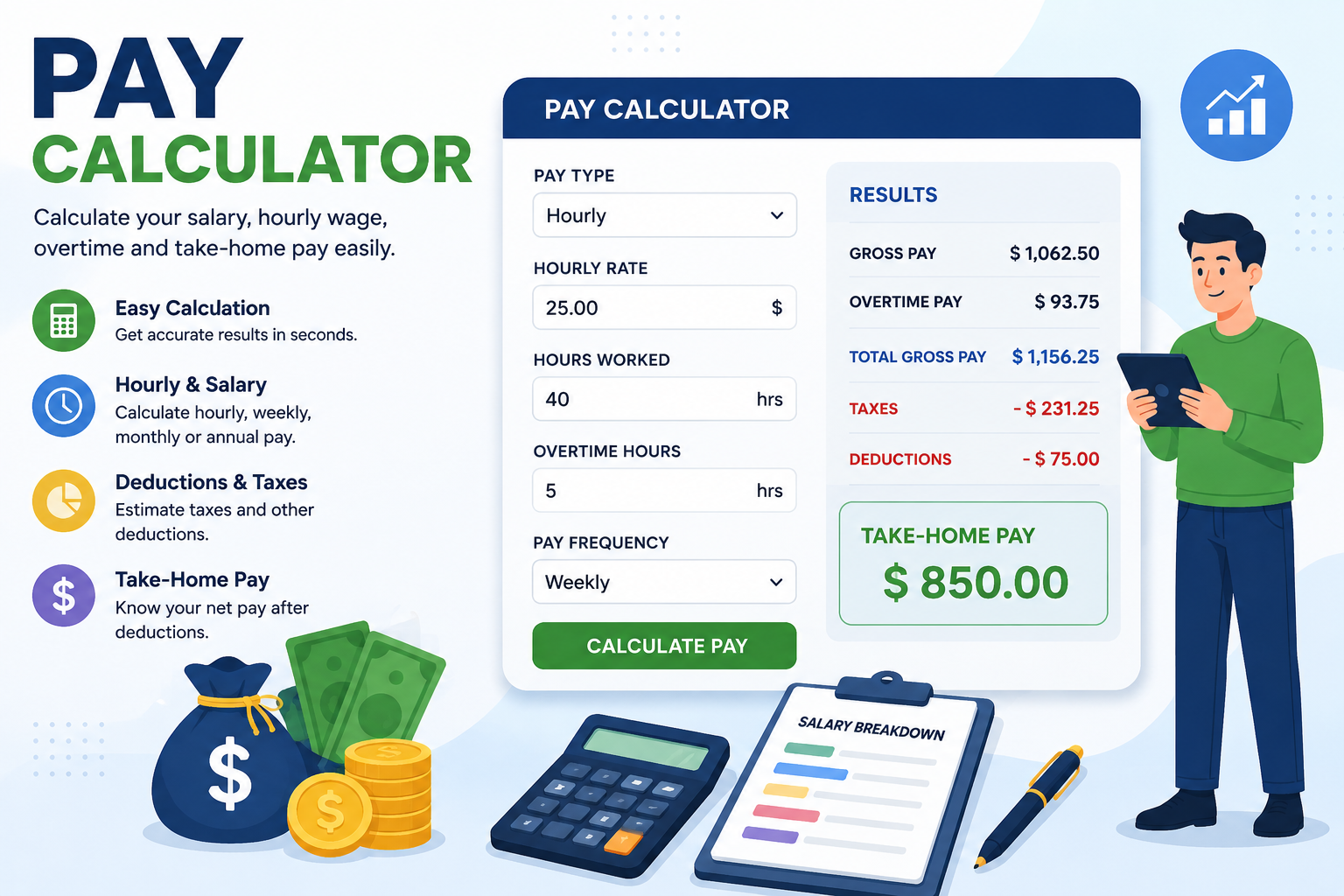
A Pay Calculator is an online tool that calculates estimated income from the information provided by the user. Depending on the calculator, you may enter your hourly rate, hours worked, annual salary, pay frequency, and deductions.
For example, if you know your hourly pay and the number of hours you work each week, you can estimate your weekly, monthly, and annual earnings.
A basic calculation can be represented as:
Gross Pay = Hourly Rate × Hours Worked
For salaried employees, the calculator can convert an annual salary into estimated monthly or weekly pay.
How Does a Pay Calculator Work?
Using a Pay Calculator is generally simple. First, enter your salary or hourly wage. Next, provide the number of hours worked if required. You may also select your pay frequency.
Common pay frequencies include:
- Weekly
- Biweekly
- Semimonthly
- Monthly
- Annually
The calculator then processes the information and provides an estimated pay amount.
Some advanced calculators may also allow users to enter taxes, retirement contributions, insurance payments, and other deductions to estimate take-home pay.
Gross Pay vs. Net Pay
One of the most important things to understand when calculating salary is the difference between gross pay and net pay.
Gross Pay
Gross pay is the amount you earn before deductions. It may include your regular wages, salary, overtime, bonuses, or other earnings.
Net Pay
Net pay is the amount remaining after applicable taxes and other deductions have been taken out. This is often called take-home pay.
A Pay Calculator can help users understand the difference between these two amounts.
Pay Calculator for Hourly Employees
Hourly workers can use a Pay Calculator to estimate earnings based on their hourly wage and working hours.
For example, if an employee earns $20 per hour and works 40 hours per week, the basic weekly gross pay would be:
$20 × 40 = $800
This is a simple example and does not include taxes, overtime, or other deductions.
If overtime applies, the final amount may be higher depending on the employee’s overtime rate and applicable rules.
Pay Calculator for Salaried Employees
Salaried employees usually receive a fixed annual salary. A Pay Calculator can help convert this annual amount into different pay periods.
For example, an annual salary can be divided into estimated:
- Monthly pay
- Weekly pay
- Biweekly pay
- Daily pay
This makes it easier to understand how an annual salary translates into regular paychecks.
Why Use an Online Pay Calculator?
There are several reasons people use online salary and pay calculators.
Saves Time
Manual calculations can take time, especially when taxes and deductions are involved. An online calculator can provide an estimate much faster.
Easy to Use
Most calculators require only a few pieces of information, making them accessible to beginners.
Helps With Budgeting
Knowing your estimated income can help you plan expenses, savings, and other financial goals.
Useful When Comparing Jobs
If you are comparing different job offers, a calculator can help you understand how different hourly rates or annual salaries may affect your estimated earnings.
Pay Calculator With Taxes
Some calculators include tax estimation features. These tools may allow users to enter information such as location, filing status, or other relevant details.
The calculator can then provide an estimated net pay after potential deductions.
However, tax calculations can vary significantly depending on local laws, personal circumstances, benefits, and other factors. Therefore, calculator results should be treated as estimates rather than official tax calculations.
Pay Calculator for Overtime
Employees who work additional hours may want to estimate overtime earnings. A calculator can help combine regular hours with overtime hours.
For example, you can enter your regular hourly rate, normal working hours, overtime hours, and overtime rate if supported by the tool.
This can provide a clearer estimate of total gross earnings for a particular pay period.
Pay Frequency and Your Earnings
Pay frequency affects how often you receive a paycheck, but it does not necessarily change your annual salary.
For example, an annual salary may be distributed through weekly, biweekly, semimonthly, or monthly payments.
Understanding your pay frequency can help you plan your monthly expenses and manage cash flow more effectively.
How to Get More Accurate Results
To get a useful estimate from a Pay Calculator, make sure the information you enter is correct.
Check your:
- Hourly wage or annual salary
- Regular working hours
- Overtime hours
- Pay frequency
- Applicable deductions
- Bonuses or additional income
- Tax information, when required
Remember that actual paycheck amounts can differ from calculator estimates because of employer-specific deductions, taxes, benefits, and other factors.
Who Can Use a Pay Calculator?
A Pay Calculator can be useful for employees, job seekers, employers, freelancers, and students learning about personal finance.
Job seekers can use it to compare potential salaries. Employees can estimate their regular earnings, while freelancers can use similar calculations to understand income based on working hours and rates.
Conclusion
A Pay Calculator is a convenient way to estimate earnings without performing complicated calculations manually. It can help you understand hourly wages, annual salaries, gross pay, net pay, overtime, and different pay frequencies.
Whether you are starting a new job, comparing employment offers, planning a budget, or simply trying to understand your paycheck, an online Pay Calculator can provide a quick estimate.
For the most accurate financial planning, always review your actual paycheck and official tax or payroll information, since calculator results may not include every deduction or individual circumstance.
Understanding Your Pay With a Pay Calculator
A Pay Calculator can make it much easier to understand how your earnings are calculated. Many people know their hourly wage or annual salary but may not know exactly how much they earn per week, month, or year. By entering basic information into a calculator, you can get a quick estimate of your income for different pay periods.
For hourly employees, the calculation usually depends on the hourly rate and the number of hours worked. If you work different numbers of hours each week, a Pay Calculator can help you estimate how those changes may affect your total earnings. This can be particularly useful when working overtime or taking additional shifts.
Calculate Weekly and Monthly Pay
One useful feature of a Pay Calculator is the ability to convert your income into different time periods. For example, an hourly wage can be used to estimate weekly earnings based on your regular working hours. The same information can then help estimate monthly and annual income.
Salaried employees can also benefit from these calculations. If you know your annual salary, you can estimate how much you earn per month, week, or pay period. This gives you a clearer picture of your income and can make personal budgeting easier.
Planning a Personal Budget
Knowing your estimated income is an important part of creating a budget. A Pay Calculator can help you understand how much money you may receive before and after certain deductions. Once you have an estimated take-home amount, you can organize your spending around important categories such as housing, food, transportation, education, savings, and entertainment.
A calculator does not replace your actual paycheck, but it can provide a useful starting point for financial planning.
Comparing Job Offers
A Pay Calculator can also be useful when comparing different employment opportunities. One job may offer a higher hourly rate, while another may provide a higher annual salary or additional benefits.
For example, you can compare two hourly rates by entering each rate and the expected working hours. If one position includes overtime, bonuses, or different working schedules, you can calculate separate estimates to understand the potential difference in earnings.
Remember that salary is only one part of a job offer. Benefits, working hours, paid leave, insurance, retirement contributions, and other conditions can also affect the overall value of employment.
Understanding Deductions
Your gross earnings are not always the same as the amount you receive in your bank account. Various deductions may be taken from a paycheck depending on your location and personal circumstances.
These can include applicable taxes, insurance premiums, retirement contributions, and other payroll deductions. Some online Pay Calculator tools allow users to enter deductions so they can estimate their net or take-home pay.
Because deductions vary from person to person, calculator results should be considered estimates.
Pay Calculator for Overtime
Overtime can significantly affect total earnings for employees who work beyond their normal schedule. A Pay Calculator may allow you to enter regular hours and overtime hours separately.
For example, you can enter your standard hourly rate, regular hours worked, and additional overtime hours. The calculator can then estimate your total gross earnings for the selected period.
Always check the overtime rules that apply to your employment and location because overtime rates and eligibility can differ.
Why Accurate Information Matters
The accuracy of a calculator’s result depends on the information you provide. Make sure your hourly rate or annual salary is correct. You should also enter realistic working hours and select the correct pay frequency.
If the calculator includes tax or deduction options, provide the appropriate information where required. Even small differences in the input can change the estimated result.
Helpful Tool for Everyday Financial Planning
A Pay Calculator is more than a simple mathematical tool. It can help employees understand their income, compare employment options, estimate overtime earnings, and plan a personal budget.
Whether you are paid hourly or receive an annual salary, understanding your earnings can help you make better-informed financial decisions. Use the calculator regularly when your salary, working hours, or deductions change, and compare the estimate with your actual paycheck for a clearer understanding of your income.
One Response